
Is your business sale ready? A five-step way to find out
Most business owners think about selling in terms of numbers, such as how much the business is worth, and when it can reach that figure. But long before prospective buyers look at accounts, they’re forming a view on something much harder to quantify: whether the business, and its owner, are truly ready for sale.
In this guide, Price Bailey’s SCF advisers outline five areas owners can assess to determine whether their business is sale ready. Where it is not, the assessment can help identify the gaps and areas of work needed well ahead of a future exit.
An owner whose thinking about an exit shouldn’t start with a valuation, instead, they should be assessing their preparedness, by working through the following five questions in order:
- What do the shareholders want from a deal? And are they aligned?
- Who is realistically going to buy the business?
- What does this business need to look like to optimise the outcome for shareholders?
- How far is the business from that today?
- What’s the plan to close that gap?
The businesses that sell well, and for the value owners expect, are the ones that take their time through these steps, working years, not months ahead. Here’s what each step actually involves:
Step one: Identify the shareholder’s desired outcome
Before anything else, work out what result you want for you, not what you think should want, and not what a friend achieved when they sold their business.
This matters significantly more with owner-managed businesses than the deal value alone suggests, because the answer is usually more than just money. It’s a combination of value, conditionality, ongoing role and timing, and all four shape who will potentially buy the business and how the deal is structured.
A surprising number of owners go into a sale process without a clear answer, get approached, and end up agreeing to a deal dictated by someone else’s agenda rather than their own. The result can be seller’s remorse: feeling pushed into a transaction that never matched what they wanted.
The questions worth considering early are:
- Do you want to walk away on day one, or are you prepared to stay involved for a period after the deal completes? If so, how long are you happy to work for someone else rather than yourself?
- What do you want life to look like after the sale, beyond the headline value?
- Do you want to provide for children, or the next generation, from the proceeds?
- Is there anyone in the business, such as a managing director or long-serving employees, you want to look after as part of the deal?
Most sellers are asked to stay involved with the business, often part-time, for two to three years after completion, and part of the deal value is usually tied to that ongoing involvement. The more responsibility you’ve already passed onto a second layer of management, the less value needs to be attached to you personally staying.
Timing on legacy planning is equally important. Owners who only start thinking about looking after key people in the final months before a sale are usually limited to paying bonuses, which can be tax inefficient. Owners who plan a few years ahead have more options, such as a share option scheme put in place well before a sale.
Getting clarity on these details is not only good practice, but directly influences the type of buyer you’ll be selling to, which leads into the next question.
Step two: Understand who will buy your business
Value is largely driven by demand and competitive tension, which means the real question is: how many buyers, with the appetite and the funds to act, actually exist for a business like yours?
Highly niche businesses can be difficult to sell, simply because there aren’t many buyers who understand or want that specific model.
Scale also plays a significant role. Very small businesses tend to be overly reliant on their owners, harder to run once the owner steps back, and not sizeable enough to be strategically important to potential buyers. The wider the pool of businesses that operate in your sector, the greater the number of potential buyers, resulting in increased competitive tension, which drives value up. Being too niche or too small shrinks that pool, and with it, your options.
It’s also worth researching what characteristics attracted buyers to other businesses that have sold in your sector recently. Is it consolidation, private equity interest, or something specific about the model? That pattern usually tells you a lot about who’s likely to come knocking, and what they value.
Step three: Identify what drives your value
Owner-managed businesses are often valued using a multiple of historic earnings, particularly where reliable forecasts are unavailable. However, buyers are ultimately investing in the business’s future performance, not simply what it has achieved in the past.
A question to consider is: how strong and predictable are earnings going forward? And are they increasing or declining? Recurring revenue is a strong indicator that earnings are of higher quality, and this can come in several forms, including:
- Customers with a strong pattern of repeat business.
- Long-term contracts, or subscription-style agreements.
- Annual service contracts, such as a business that services equipment under yearly repeat agreements.
- Technology, specialist facilities, or other intellectual property that creates stickiness, making it harder for customers to switch away.
On the other hand, several factors weaken quality of earnings, including heavy reliance on a small number of customers, where losing just one could materially affect revenue, contracts approaching renewal that haven’t yet been secured, and products or services with a limited shelf life, where market change puts future demand at risk.
It also helps to understand that value builds in layers, not as a single multiple. The diagram below shows how those layers stack, and where you can act to move up them. Financial performance forms the base. Above it sit your growth prospects, then the technology and intellectual property that make you hard to replace, then the synergies a particular buyer could realise by combining your business with theirs. At the very top sits a strategic premium, which only applies where a buyer needs your business specifically, not just a business like it.
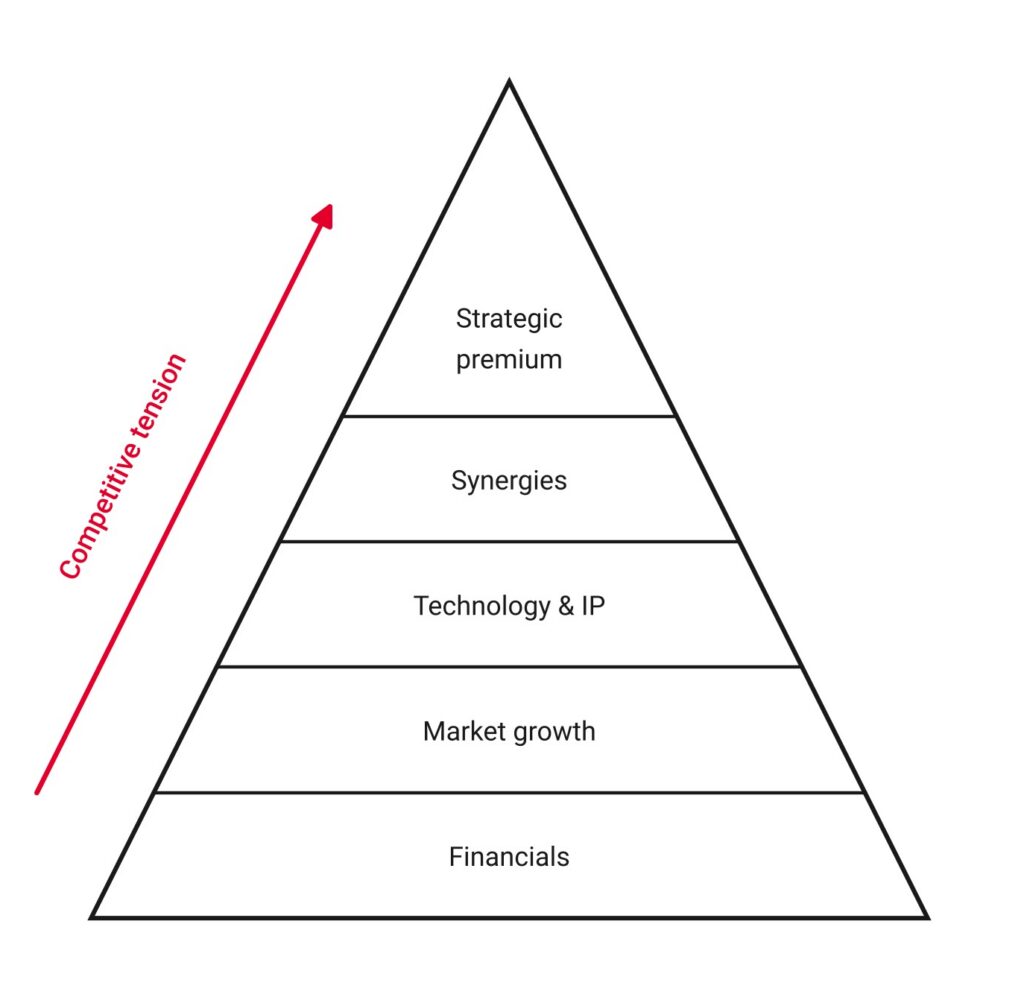
The further up that stack you can credibly reach, the more your business is worth beyond a straightforward earnings multiple, and competitive tension between buyers is what pulls value up through the layers.
Step four: Work out how far you are from being ready for sale
Once you know what you want, who might buy your business, and what drives value, you can honestly assess the gap between where the business is now and where it needs to be. You may be closer than you think; alternatively, you may be a long way from your goals, in which case the goals themselves may need to be more realistic, or you’ll need to allow yourself more time to reach them.
There is no single answer to how long that takes, because it depends entirely on the size of the gap. As a general steer, the deal process itself, once you’re in it, can take around nine months on average. Preparation time is a separate question, and it varies significantly:
- If your systems, controls, and financial information are already strong, preparation might only take a month or so of gathering and organising information.
- If your accounts and reporting need real work, a few months is more likely.
- If you also want to do tax planning or corporate restructuring ahead of a sale, that can take a couple of years.
- If you need to grow the business to reach the value you want, that could take several years of planning and execution.
Readiness is also not the only factor, buyer appetite and market conditions matter too.
Start with the basics. Have you got the right reporting processes and governance structure? Governance will help you deliver your plans and create accountability, while reporting will help you measure successes and determine if plans need to change.
Step five: Build the plan for the end game
A good end-game plan covers the entire business, and often personal or family matters. It should address risk and how to mitigate it, as well as setting out how you’ll measure progress. In practice, that plan tends to cover the same handful of areas, whatever the business.
Management: Build a team that reduces the business’s reliance on you personally. That means having a management team in place who can carry the business forward, and being able to show, ahead of a sale, that you’re already stepping back. That could be as simple as reducing your working days in the run-up to a deal, so buyers can see the business performs without your day-to-day involvement. Buyers won’t acquire a business that risks failing the moment the owner leaves, and this kind of change takes time to embed convincingly. It isn’t something you can demonstrate credibly in the final few weeks before a sale.
Management information: Buyers don’t just want to understand your trade, they want to see the operational backbone behind it, and owner-managed businesses often underinvest here, running the business on instinct rather than data. When a buyer expects monthly management accounts broken down by product and region, but the business only produces figures quarterly or annually, due diligence can stretch by weeks or months while the business reconstructs that detail after the event. Not only does poor information slow a deal down, but it can hit value or kill the deal completely.
Tax: Tax is usually the biggest cost of any deal, so getting advice early is one of the most effective ways to mitigate it. It’s also the area where a corporate structure gets tested.
Cash, debt, and working capital: The final sale price gets adjusted for the business’s surplus cash, debt, and working capital. This adjustment can be significant. Reducing your working capital cycle ahead of a sale helps maximise the cash you walk away with, on top of the headline price.
Operational issues and skeletons: Tax history, litigation, contract renewals, and capital expenditure requirements all get reviewed closely during due diligence, and any outstanding issues need dealing with before they deter buyers or create future liabilities. Failure to do so can delay deals by several months or stop them from proceeding all together.
The common thread that runs through all of this is honesty. A common misconception is that deals fail because of a problem itself; in reality, they fail when a buyer discovers a problem late in the process and begins to wonder what else hasn’t been disclosed. So, being open about known issues, and framing them fairly, keeps a deal moving.
Right deal team: None of the above works well without the right people around you. Assemble an experienced deal team you trust to give you the best advice, even when it challenges your own thinking, and do it as early as possible. The longer you’ve had proper legal, tax, and corporate finance advice in place before going to market, the more prepared you’ll be across every part of the process, and the more flexibility you’ll have when things need to change.
Why it pays to start this process early
The business owners that start working through these five steps years, not months, before they plan to sell, are most likely to get the outcome they seek.
It should also be noted that the early conversation doesn’t need to lead anywhere immediately. It might simply flag a handful of small, practical changes: tightening up a particular system, building out the second layer of management, or gradually reducing your day-to-day involvement so a buyer can see, credibly, that the business doesn’t depend on you.
None of that happens overnight. But starting early gives you the option of doing it properly, rather than trying to compress years of preparation into the final few months before a deal.
Next steps
If you’re starting to think about exit, even if a sale is still some years away, it’s worth working through these five steps with an adviser. The sooner you understand where you are against where you need to be, the more options you’ll have when the time comes. Fill in the form below to speak with one of our advisers today.
We always recommend that you seek advice from a suitably qualified adviser before taking any action. The information on this page is intended as a general guide only. While we work to keep our content accurate and up to date, we cannot guarantee that it reflects the position at the time you are reading it. No responsibility for loss occasioned by any person acting or refraining from action as a result of this material can be accepted by the authors or the firm. For more information on our editorial process, click here.
Sign up to receive exclusive business insights
Join our community of industry leaders and receive exclusive reports, early event access, and expert advice to stay ahead – all delivered straight to your inbox.