
The future of AI in UK Hospitality
How hotels and restaurants will really use AI, automation and robots
The current economic environment is saturated with proclamations that AI will reshape every industry, and while this is true in many cases, the hospitality industry deserves a more considered analysis.
Based on our client experience and sector insight, we believe that AI will arrive in UK hospitality as an incremental, ROI-led, and largely invisible shift, focused on smoothing out operations rather than removing people from the front line.
Compared with other industries, hospitality is likely to take a slower, more selective approach to AI and related technologies. Where adoption does happen, it will help streamline systems and processes and support better decision-making, while preserving the human elements that sit at the heart of the hospitality industry, especially in high-end and experience-led concepts where human service is central to the brand.
In this blog, we explore where AI is already creating value in hospitality, where human service remains irreplaceable, and why adoption will be shaped more by ROI and operating pressure.
The financial reality: Can hospitality businesses afford to implement AI?
When considering the implementation of AI in hospitality, it’s crucial to start with the financial position from which these decisions are being made. UK hospitality businesses have been under sustained pressure since Covid-19, and 2026 has only added to that, bringing an energy shock, continued inflation, National Minimum Wage increases, reduced National Insurance thresholds, and for some, higher business rates.
That combination leaves little headroom for discretionary technology spend. For many hospitality businesses, whether independent restaurants, boutique hotel groups or regional pub chains, the choice is stark: invest in technology that could look entirely different in 12 months, or direct limited capital towards marketing, staff and the daily fundamentals of the guest experience.
As more of the guest journey moves online, from initial discovery to booking, operators are also being pushed to invest in digital marketing, content and other high-skilled roles that support those channels, which further competes with technology budgets.
Until there is more breathing space, AI investment will only happen where there is a very clear and near-term commercial return. This dynamic also risks creating a two-speed landscape, whereby larger groups with stronger balance sheets are better positioned to invest in technology and AI, while smaller operators may struggle to do much more than keep up with rising costs.
Where AI is actually being used
Despite the economic constraints for most businesses, AI in hospitality is not theoretical. A 2026 study from Access Hospitality found that 28% of UK and Ireland hospitality operators are already implementing AI tools across multiple departments, with a further 20% exploring how it could be used in their business.
Where AI is being used, it is primarily in the less glamorous parts of the operation. Recent research from RMS and RoomPriceGenie shows that hospitality businesses worldwide are now juggling close to ten different systems and losing hours every week to disconnected tools, failed syncs and data issues.
This is exactly where AI and automation are starting to gain traction: cleaning up data, connecting systems and taking repetitive tasks off already stretched teams. But these tools can only ever be as good as the systems, data and people behind them. Without accurate and integrated booking, PMS, POS and finance data, AI-driven insight or automation will be ineffective.
Overall, we are seeing clients use AI tools to simplify bookings and payments journeys, and to tidy up data infrastructure so that operators can access better insights and more accurate accounting information. From there, several specific use cases are emerging that we expect to see more widely:
Review management
AI tools can analyse thousands of guest reviews simultaneously, identifying recurring themes and flagging urgent issues. This then enables operators to make improvements quickly without dedicating staff hours to manual reading.
Responding consistently to guest reviews improves both ratings and online visibility, with a measurable downstream impact on bookings.
Automated logistics
Some serviced apartment and hotel operators are using AI to predict cleaning requirements based on occupancy data and automatically schedule resource.
For example, if eight guests check in for five nights, the system calculates and books the appropriate cleaning time without manual intervention, reducing scheduling errors, overtime and last‑minute agency spend.
Personalised marketing
Where guest data is captured at booking or check-in, AI enables more targeted marketing campaigns based on previous behaviour. A returning guest might receive a tailored offer on a spa treatment they booked during their previous stay, or a midweek rate aligned with their usual stay pattern.
Surveys suggest many guests now expect some level of AI-powered personalisation in brand interactions, which gives operators space to use these tools without undermining trust.
Self-service check-in and ordering
Self-service kiosks, tablet ordering and QR-code menus work well where guests expect a functional, transactional experience, such as mid-market chains, budget hotels and fast-casual venues.
In these environments, removing friction and queue time is a clear win, and guests are comfortable trading interaction for speed.
All of these examples represent a common thread, in which AI is used to reduce administration, improve accuracy and free up staff, not to eliminate roles wholesale.
What AI can’t replace
Access Hospitality’s study presents a seemingly positive uptake of AI in the sector, but when viewed the other way around, it demonstrates that over half of UK and Ireland operators are not engaging with it at all.
This underlines that the hospitality sector is still a cautious adopter compared to other sectors, and while it is partly due to the financial constraints we touched upon, it also stems from the fact that many of the most important roles in the sector are fundamentally human, even when elements of them can be automated.
These broadly fall into three categories:
- Creative roles: Chefs and kitchen teams designing menus, plating dishes and managing live service. Automation can support consistency and efficiency, but it cannot replace taste, judgement and the individual creativity which often creates a selling point.
- Relationship-driven roles: Waiting staff, bartenders and front-of-house managers who build rapport, read the room and handle complex, emotional interactions in real time.
- Experience-driven roles: This applies to high-end and luxury settings, where reception staff and hosts are central to brand promise. In such cases, the service is part of the product, not just a delivery mechanism.
There are also areas of the sector, specifically high-end and luxury hospitality, where a highly personal service, delivered by a human being, is crucial to their brand proposition.
In these settings, guests are not just paying for the room, table or amenities themselves, but for attentiveness, discretion and judgement in the moments that matter most. At the top end of the market, guests expect that the most important parts of the experience will be handled by a person, not by AI.
That does not mean technology has no role to play. In fact, many guests now expect digital convenience around the edges of their stay, whether that is a smoother booking journey, quicker responses to enquiries or self-service options for lower-stakes tasks.
But when service becomes more personal, emotional or complex, the value shifts back towards human interaction. In those businesses, AI is more likely to be used behind the scenes to remove friction, support teams and deepen personalisation, rather than becoming part of the visible service experience itself.
The case for humanoid robots
Despite most AI and technology adoption in UK hospitality remaining behind the scenes, the use of humanoid and service robots as a unique selling point, while still niche, is becoming more common, especially as the demand for experience-led models increases. These are typically deployed as reception or concierge assistants, robotic waiters, or cleaning and delivery support in hotels and restaurants where the technology itself becomes part of the brand and provides a talking point for guests.
Several UK suppliers now offer serving, reception and room‑service robots that can escort guests to tables, deliver food and drink, or move through corridors and lobbies with basic wayfinding and voice interaction. For concepts such as buffets, family‑orientated venues and experience‑led brands, this kind of visible automation creates a point of difference that guests actively notice, photograph and share, generating social media attention alongside operational support.
A great example of this balance in action is Yari Club, a Japanese restaurant concept in London’s Covent Garden, which uses an automated rotary grill that turns skewers over the flame, dips them in sauce and chars them in full view of guests.
This theatrical element adds a distinctive dimension to the concept and helps attract visitors alongside the food itself. Even so, the restaurant still relies on human staff to load the skewers, oversee quality and manage the guest experience, showing that while the technology adds consistency and novelty, the hospitality remains firmly human.
Additionally, the financial barrier for this type of investment is still high. Humanoid and branded service robots are capital‑intensive and best suited to larger or highly experience‑led operators that can justify the investment and turn it into a genuine marketing asset. For most UK hospitality businesses, particularly SMEs already facing rising wage and operating costs, AI is likely to deliver more immediate and practical value through software and data‑driven tools than through visible humanoid robots.
What operators should do now
For operators who do have the capacity and headroom to start investing in AI, the goal shouldn’t be to try and automate everything, but to consider where technology can create value without undermining the business’ proposition. Some practical principles may include:
Prioritise back-of-house and admin-heavy tasks first
- Focus on tools that reduce manual scheduling, reporting, reconciliation and data clean-up. These areas offer clear time savings and cost reductions without risking the guest experience.
Avoid large, inflexible bets
- Opt for modular, multi-use tools that integrate with existing systems rather than large, bespoke platforms that will be hard to unwind if the technology or your needs change.
Get your data foundations right
- Before chasing more advanced AI, ensure your bookings, PMS, POS and finance data are accurate, connected and usable. The value of any AI layer is only as strong as the data underneath it.
- Operators who take this selective, ROI-led approach will be better placed to benefit as the technology matures, without tying up scarce capital or damaging their guest experience.
The bottom line
AI in hospitality will not dramatically replace guest-facing, front-of-house roles. Instead, it will provide a quiet, operational upgrade, driven by financial necessity rather than technological ambition, and will focus on removing friction behind the scenes while keeping people at the front and centre.
Until the UK becomes a more stable and financially secure environment for hospitality businesses, many operators will remain preoccupied with paying the bills rather than experimenting with new technology.
Operators with the capacity to invest will use AI to automate systems, logistics and marketing, and to support their teams rather than replace them. A smaller group will continue to use visible robotics as a deliberate brand feature, not simply as a cost-cutting measure.
The real opportunity lies in using AI to make hospitality businesses run better, and to give human hosts more time and space to do what only they can do. To learn more about our hospitality services, speak to a member of our team using the form below.
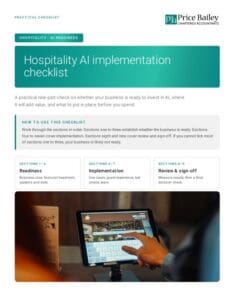
Download our free checklist to assess where AI could add value to your hospitality business, and what to consider before investing.
We always recommend that you seek advice from a suitably qualified adviser before taking any action. The information on this page is intended as a general guide only. While we work to keep our content accurate and up to date, we cannot guarantee that it reflects the position at the time you are reading it. No responsibility for loss occasioned by any person acting or refraining from action as a result of this material can be accepted by the authors or the firm. For more information on our editorial process, click here.
Sign up to receive exclusive business insights
Join our community of industry leaders and receive exclusive reports, early event access, and expert advice to stay ahead – all delivered straight to your inbox.