
Contentious Tax Bulletin
Tax Investigations Partner, Andrew Park, provides a round up of the most recent and significant contentious tax news
In the September 2026 bulletin, Andrew Park, Tax Investigations Partner at Price Bailey, provides an overview of some of the most recent and significant contentious tax news, legislative changes, updates, and relevant case decisions that occurred throughout the month.
HMRC initiatives and new legislation
- HMRC one-to-many texts and emails to people who may now be subject to the new Foreign Income and Gains (“FIG”) rules
During the month, HMRC began sending emails and text messages to individuals whom it believes may be affected by the Foreign Income and Gains (“FIG”) regime, based on information in their Self Assessment returns. The communications direct recipients to HMRC guidance explaining who may qualify, how the new regime operates and how a claim is made.
The FIG regime replaced the remittance basis from 6 April 2025. Broadly, qualifying new residents may claim relief on eligible foreign income and gains arising during their first four tax years of UK residence following at least ten consecutive years of non-UK residence. A separate claim is required for each year and claimants lose their personal allowance and annual exempt amount, so the position should be reviewed rather than assuming that a claim is beneficial.
The standard wording of the email communications can be viewed here:
Case decisions
-
J Scheckter v HMRC [2026] UKFTT 1280 (TC)
The First-tier Tribunal (“FTT”) has dismissed an appeal by Jody Scheckter, the former Formula One driver, against closure notices denying sideways loss relief for losses arising from Laverstoke Park Produce LLP in 2007/08 to 2009/10. The LLP carried on an organic farming and food production business alongside a connected company responsible for processing and retail activities. He had sought to set his share of those farming losses against his other income in the relevant tax years and, for 2008/09, against capital gains.
HMRC challenged this use of sideways loss relief on the basis that the claims were barred by three restrictions in ITA 2007:
- First, the LLP’s trade was not carried on a commercial basis, contrary to s66(2)(a).
- Secondly, it was not carried on with a view to the realisation of profits, contrary to s66(2)(b).
- Thirdly, because the trade was farming and had generated losses in each of the previous five tax years, s67(2) applied; HMRC disputed that the farming trade was ancillary to a larger trading undertaking so as to fall within the exception in s67(3)(a).
The Tribunal accepted that the LLP and the company could together form a larger trading undertaking, notwithstanding that they were separate legal persons. It also held that the farming trade was carried on with a view to the realisation of profits of that larger undertaking, so HMRC did not succeed on the s66(2)(b) profit-realisation argument. However, the farming trade was not ancillary to the larger undertaking for the purposes of s67 ITA 2007 because it was not merely subordinate or supportive of the wider business. Farming was the LLP’s predominant activity and lay at the heart of the integrated enterprise: the company’s processing and retail operations depended on the animals and produce generated by the farm, rather than the farm existing simply to support an independently dominant trade. Nor was the farming trade carried on a commercial basis for s66 purposes. Most significant was the failure to charge the connected company for its use of the LLP’s valuable brand. The appeal was therefore dismissed on the commercial-basis and farming-loss restrictions, not because the profit-realisation test was failed.
Why this matters
The decision is a useful reminder that a genuine profit motive is not enough: commerciality is judged objectively, and connected businesses must transact on a properly documented commercial basis. It also confirms that a “larger trading undertaking” can span more than one legal entity, although that finding will not by itself overcome the special restriction on sustained farming losses.
-
The Commissioners for His Majesty’s Revenue and Customs v British Airways plc [2026] UKUT 00366 (TCC)
The Upper Tribunal has dismissed HMRC’s appeal against an FTT decision in BA’s favour concerning hotel accommodation provided by BA to cabin crew during mandatory rest periods at Heathrow between back-to-back transatlantic rotations. Approximately £5.78 million of Income Tax and National Insurance contributions was at stake under an agreement applying the result across 2016 to 2020.
The Tribunal held that the cost was deductible under s337 ITEPA 2003. The entire rotation was both the crew member’s job and the relevant journey; it did not end merely because the aircraft involved stopped at Heathrow. Once the 2016 aviation safety rules made use of the accommodation compulsory, the Heathrow stay was a necessary expense of travel in the performance of the employment duties. HMRC’s appeal was dismissed.
Why the decision matters
The decision shows that accommodation at or near an employee’s permanent base is not automatically a taxable benefit. The statutory test remains intensely fact-sensitive: the key features here were that the whole rotation constituted the duties and journey, and that the rest accommodation was mandatory rather than chosen for personal convenience.
-
Smith v HMRC [2026] UKFTT 01351 (TC)
The appellant purchased an eight-bedroom house set in approximately three acres in Kent, for £2.6 million in December 2023. He claimed Multiple Dwellings Relief (“MDR”) on the basis that a detached building beside the outdoor swimming pool, described in the sales particulars as a pool house but referred to in the proceedings as “the Annexe”, was a second dwelling.
The Annexe was more than 200 feet from the main house and had its own driveway, lockable entrances, kitchen facilities, shower, lavatory, heating and electrical fuse board. If MDR applied, the SDLT was £220,500; without it, the liability was £301,250, a difference of £80,750.
HMRC challenged the use of the relief on the basis that the Annexe was not objectively suitable for use as a separate dwelling at completion. In particular, it argued that the main room was too small to provide adequate sleeping and entertaining space, that there was insufficient storage for ordinary domestic occupation, and that the Annexe lacked the privacy and security required of an independent home because occupants of the main house would continue to use the swimming pool and, in practice, the Annexe’s shower and lavatory. HMRC also relied on the shared postal address, council tax assessment and utility meters as factors pointing away from independent occupation.
The FTT applied the multi-factorial test in Fiander and Brower v HMRC and asked whether, at the effective date of completion, the Annexe was objectively suitable for use as a single dwelling. It accepted that the building could meet basic living needs and rejected HMRC’s arguments that there was insufficient space for sleeping, entertaining or storage. However, the shared use of the pool meant that it did not provide the privacy and security expected of a separate dwelling. It was not objectively realistic to assume that the occupants of the main house would surrender use of the pool; in practice, their use of it would also involve access to the Annexe’s shower and lavatory. That arrangement would only work for a particular class of occupier, such as relatives or friends, rather than occupiers generally.
The Tribunal therefore held that the Annexe was not suitable for use as a single dwelling for the purposes of paragraph 7(2)(a) Schedule 6B FA 2003. MDR was unavailable and the appeal was dismissed.
Why the decision matters
Although MDR was abolished by Chancellor Jeremy Hunt for most transactions completing on or after 1 June 2024 because of widespread perceived abuse, the decision remains relevant to historic claims and transactions protected by the transitional rules. It confirms that physical separation and a full range of domestic facilities are not conclusive. Suitability is assessed in the round at completion, and practical arrangements affecting privacy, security and genuine independent occupation may defeat a claim even where an annexe appears self-contained on paper.
Other news and announcements
-
Price Bailey Freedom of Information (“FoI”) request shows surge in overseas tax authorities seeking taxpayer information from HMRC
As reported in the Daily Telegraph, FoI data obtained by Price Bailey shows that HMRC received 1,772 targeted information requests from foreign tax authorities in 2025, the highest figure for seven years and 20% more than in 2022. Over the same period, HMRC’s requests to overseas authorities fell by 39%, from 697 to 424.
The figures suggest that overseas authorities are increasingly converting automatically exchanged data under frameworks such as the Common Reporting Standard and FATCA into targeted enquiries.
Specific requests can seek information beyond account balances, including historic property transactions, income from digital platforms and activity on international cryptoasset exchanges.
Taxpayers with cross-border affairs should assume that information held by one authority may be available to another and should correct any omissions before an enquiry begins.
-
Price Bailey Freedom of Information (“FoI”) request shows surge in overseas tax authorities seeking taxpayer information from HMRC
As reported in the Daily Telegraph, FoI data obtained by Price Bailey shows that HMRC received 1,772 targeted information requests from foreign tax authorities in 2025, the highest figure for seven years and 20% more than in 2022. Over the same period, HMRC’s requests to overseas authorities fell by 39%, from 697 to 424.
The figures suggest that overseas authorities are increasingly converting automatically exchanged data under frameworks such as the Common Reporting Standard and FATCA into targeted enquiries.
Specific requests can seek information beyond account balances, including historic property transactions, income from digital platforms and activity on international cryptoasset exchanges.
Taxpayers with cross-border affairs should assume that information held by one authority may be available to another and should correct any omissions before an enquiry begins.
-
HMRC expected to issue c. 1.8m simple assessments for 2025 /26
Simple Assessment is HMRC’s mechanism for calculating and demanding Income Tax where tax is due but cannot be collected through PAYE and HMRC does not require a full Self Assessment return. The taxpayer receives a PA302 calculation based on information already held by HMRC, commonly concerning State Pension income and bank or building society interest.
HMRC expects to issue approximately 1.8 million Simple Assessment letters for 2025/26, compared with 675,000 for 2021/22. The increase is partly attributable to the frozen personal allowance bringing more pensioners and savers into tax. A further tranche of simple assessments, reflecting bank and building society interest data, is expected between October and December 2026.
A recipient should check the calculation against relevant pension statements, P60s and interest records rather than assume HMRC’s figures are correct. If the assessment is wrong, HMRC should be contacted within 60 days of the notice. For 2025/26, tax shown on a notice received before 31 October 2026 is generally due by 31 January 2027; where the notice is received on or after that date, payment is generally due within three months.
What happened in August 2026
HMRC initiatives and new legislation
-
Educational letter issued by HMRC to executors treating estates as “excepted”
HMRC has launched a letter campaign to the executors of estates with “excepted” assets falling closely below the nil rate band thresholds, reminding them that if there is any doubt at all about valuations or allowances, they should submit a full IHT 400 Inheritance Tax Return.
The letter briefly summarises some of the factors that should have been considered by the executors in determining the level of the nil rate bands available, including the rules involving spouses and the deceased’s home.
The letters are framed as educational in nature rather than intelligence-led.
A proforma copy of the letter can be viewed here.
Case decisions
-
HMRC v Quillan [2026] UKUT 300 (TC)
This case, appealed by HMRC to the Upper Tribunal, concerned the application of S415 ITTOIA 2005 (“S415”), which imposes an Income Tax charge where a close company releases or writes off a loan owed to it by a participator (normally a director).
Mr Quillan was the sole shareholder and director of BOH Investments Ltd. The company entered creditors’ voluntary liquidation with an overdrawn director’s loan account. Some recoveries were made, but a substantial balance remained outstanding. The liquidator ultimately concluded that no further sums would be recovered and reflected this in the final liquidation account. The company was later dissolved.
HMRC argued that the remaining balance had been “written off” and therefore gave rise to an Income Tax charge on Mr Quillan under S415 in 2018/19. Mr Quillan contended that there had been no formal write-off and therefore no S415 charge.
The FTT held for the taxpayer. It found that there had been no release or write-off of the debt for the purposes of S415, largely because there was no formal act recording a write-off.
The Upper Tribunal allowed HMRC’s appeal and reversed the FTT. It held that:
- A formal board resolution, deed of release or express accounting entry is not necessarily required to write off a loan. The crucial question is whether, viewed realistically, the company had abandoned any expectation of recovering the debt.
- The write-off occurred when the liquidator concluded that no further recoveries would be obtained and recorded that conclusion in the final liquidation documentation.
- Therefore, the director’s loan had been written off for the purposes of S415 ITTOIA and on the facts that occurred in 2018/19, the year assessed by HMRC.
The Upper Tribunal remade the FTT’s decision accordingly, and dismissed Mr Quillan’s appeal against HMRC’s closure notice.
Why this matters
This case was already one of the most significant recent decisions on participator loans. The FTT’s decision had recognised that even after liquidation the possibility remained open for the company to later be reinstated to the register and for the debt to be pursued against Mr Quillan were his circumstances to change. Accordingly, how could he fall within charge to irrecoverable Income Tax when he might still ultimately be pursued for the debt?
On the other hand, the Upper Tribunal has chosen to brutally assert substance over legal form whilst recognising that this will lead to inherent unfairness in the event that Mr Quillan or other taxpayers in his position are later successfully pursued for debts without recourse under the legislation to seek a corresponding repayment of the tax suffered under S415.
For advisers dealing with insolvent close companies and participator loans, Quillan is likely to become a leading authority on the meaning and timing of loans being “written off” under S415.
-
Jeremy Francis Herrmann v HMRC [2026] UKFTT 715 (TC)
In this case heard by the First-Tier Tribunal (“FTT”), Mr Herrmann had participated in several tax-avoidance arrangements which were subsequently found to be ineffective. In 2011, HMRC opened an enquiry into his 2008/09 tax return. A closure notice issued in 2017 required additional tax of £9,960,157, with a further £4,012 arising from consequential partnership amendments.
Over time, Mr Herrmann had made substantial payments to HMRC. When those payments were originally received and allocated, the liabilities later subjected to penalties or surcharges were fully paid at the relevant statutory dates. In November 2023, his adviser asked HMRC to reallocate earlier payments across different tax periods as part of bringing the overall account into order. HMRC initially indicated that there was little scope to move payments unless Mr Herrmann had directed their application when they were made, but a series of reallocations was ultimately implemented. Mr Herrmann also paid a further £2,363,062 and £1,348,761 on 17 and 23 November 2023 respectively, satisfying the outstanding tax and interest.
The reallocations had an unintended consequence: HMRC’s reconstructed account showed that liabilities which had previously been covered were now notionally unpaid at their historic penalty trigger dates, and therefore issued:
- “S59C surcharges” on 22 December 2023 for £611,673.92 for 2008/09 and 2009/10; and
- “Sch. 56 penalties” for 2020/21 and 2021/22 on 13 February 2024 for £202,205.
Relevant legislation
Para 1 Sch. 56 Finance Act 2009 imposes a penalty where a taxpayer “fails to pay” the specified amount of tax on or before the statutory date. For Self Assessment tax, the first penalty arises 30 days after the due date. Para 3 then imposes penalties calculated by reference to tax remaining unpaid after the relevant intervals, including further five-month and eleven-month points.
Under S59C Taxes Management Act 1970, the former surcharge regime applies where Self Assessment tax “remains unpaid” 28 days after the due date, with a further surcharge where it remains unpaid six months after that date. The language of both regimes therefore focuses on whether the relevant tax was unpaid at particular statutory points in time.
The parties’ arguments
Mr Herrmann argued that the legislation requires a factual examination of the position at each statutory trigger date. At every relevant date, the tax had been paid. A later administrative reallocation could not retrospectively alter that historical fact or create a failure to pay which had not occurred.
He also submitted that the purpose of the legislation was to encourage timely payment and deter taxpayers from withholding tax. That purpose was not undermined where the taxpayer had placed sufficient funds in HMRC’s hands by the statutory deadline.
HMRC argued that the account had to be considered after giving effect to the reallocations requested by the taxpayer. Once those adjustments had been made, the relevant liabilities appeared unpaid at the trigger dates. HMRC contended that a purposive interpretation of the legislation should allow penalties and surcharges to follow the revised allocation of the payments.
The Tribunal’s conclusions
The Tribunal treated each statutory trigger date as requiring a snapshot of the actual payment position at that time.
For the Sch. 56 penalties, the question was whether Mr Herrmann had failed to pay the relevant amount by the prescribed date. For the S59C surcharges, the question was whether tax remained unpaid on the relevant date. In each instance, the answer was no: as matters stood at the time, the relevant liability had been paid.
The statutory language is clear. It does not provide for the historic payment position to be recalculated following a later reallocation. Nor does it deem a payment never to have occurred merely because the funds were subsequently applied to another liability.
The Tribunal rejected HMRC’s purposive argument. A purposive construction assists in interpreting statutory language; it does not permit the Tribunal to introduce a retrospective charging mechanism which Parliament had not enacted. The policy of encouraging prompt payment did not require a different result because the taxpayer had, in fact, paid sufficient sums on time.
The later reallocations changed the way in which HMRC accounted for the money prospectively. They did not change the historical fact that, on each statutory trigger date, the liabilities concerned had been discharged.
The Tribunal allowed both appeals and cancelled all the late payment penalties and surcharges.
Why the decision matters
Although, as an FTT decision, it is not binding for other cases, the decision appears to confirm with persuasive authority that Sch. 56 and S59C penalties for failing to pay on time operate by reference to the true position at defined statutory dates. A later reallocation does not, by itself, rewrite history and convert tax that was paid on time into tax that was unpaid at the statutory trigger date, so a subsequent accounting adjustment cannot retrospectively create a default.
The decision is particularly relevant where substantial payments have been held or allocated across several years during a long-running investigation or avoidance dispute. Before accepting any such penalties, the payment ledger should be reconstructed as it actually stood at each statutory trigger date, not merely as HMRC’s records appear after subsequent reallocations.
Other news and announcements
-
Closure of HMRC consultation on controversial proposal to introduce a new criminal offence of recklessly making untrue statements redirect taxes
Launched in June 2026, the consultation has now closed after receiving almost unprecedented levels of opposition from many respondents, including the Institute of Chartered Accountants in England and Wales and the Chartered Institute of Taxation.
The proposal is to create a new criminal offence to sit between careless error, which is not a criminal matter, and criminal dishonesty. Although not meeting the threshold to be regarded as dishonest, under the proposal being found to have recklessly made an untrue statement to HMRC could still result in a custodial sentence of up to two years, not just for taxpayers themselves but also for professional advisers making statements on their behalf.
Serious concerns have been raised about the blurring of the distinction between carelessness and deliberate wrongdoing with the vague concept of “recklessness”, and what legitimate need HMRC has for prosecution powers where taxpayers have made non-deliberate honest mistakes, or else, the misstatements were actually deliberate, in which case, a host of criminal charging provisions already exist if that deliberate intent can be demonstrated. Moreover, the provision would jar with the position adopted by the civil tax courts that a reckless error is a careless one unless and until it crosses a threshold of “Nelsonian blindness” into dishonesty where it can be shown a conscious lack of care was taken out of suspicion that confirming the true position would have revealed a tax obligation (see CPR Commercials Ltd v HMRC [2023] UKUT 00061 (TCC)).
Part of the claimed justification for bringing in the measure for direct taxes is that consistency is required, because HMRC is already able to bring prosecutions for VAT matters where recklessly untrue statements are made. However, an argument could be made that consistency would be better achieved by withdrawal of that power for VAT because it appears to have been barely used, which seems to confirm its inherent flaws and the questionable need for it.
Interestingly, after the consultation closed in August 2026, HMRC refused to comply with a request made by Price Bailey’s Andrew Park on behalf of the Contentious Tax Group under the Freedom of Information Act 2000, to provide data on the extent to which the power has been used for VAT. In doing so, HMRC asserted that: “the Government needs a ‘safe space’ in which it is able to investigate, prepare and formulate policy away from external interference and distraction”.
What happened in July 2026
HMRC initiatives and new legislation
-
HMRC targets businesses which haven’t charged VAT on prize draws
HMRC has begun issuing One to Many letters to businesses which operate prize draws offering both paid and free entry routes, asserting that VAT should be accounted for on paid ticket sales. The campaign follows the Treasury’s February 2026 confirmation of HMRC’s view that such prize draws are not within the VAT exemption for betting, gaming and lotteries, with paid entries instead subject to VAT at the standard rate of 20%.
The issue is potentially significant for operators who have treated ticket sales as exempt or outside the scope of VAT. HMRC’s letters are not formal assessments or compliance checks, but they are intended to prompt businesses to review their VAT accounting position and correct any errors. Where VAT has not been declared, exposure may include earlier VAT periods, subject to the usual assessment time limits.
HMRC’s published position is clear, but the technical point remains controversial and a tribunal challenge by one or more effected businesses appears likely. Businesses receiving a letter should therefore take advice before responding but should not simply ignore the letters even if they have an honestly held view they have followed the law as they understand it.
Our detailed blog regarding VAT on prize draws can be read here.
You can read a copy of the VAT on sales of prize draw tickets here.
-
Reminders issued to 2022/23 claimants of Business Asset Rollover Relief
HMRC is writing to taxpayers who made provisional claims for Business Asset Rollover Relief in their 2022/23 Self Assessment returns and have not yet replaced those provisional claims with final valid claims. Rollover Relief can defer the Capital Gains Tax (CGT) arising on the disposal of a qualifying business asset where the proceeds are reinvested in a replacement qualifying asset within the relevant time limits. A provisional claim may be made where the taxpayer intends to reinvest but has not yet acquired the replacement asset by the time the original claim must be made.
For 2022/23 disposals, the deadline for making the final claim is 31 January 2027. If the taxpayer has not made a valid final claim by then, HMRC will withdraw the provisional claim and the deferred CGT will become payable. HMRC’s letters explain what information is required and note that taxpayers can use form HS290 to make the claim. Where the taxpayer has not acquired, and does not intend to acquire, a qualifying replacement asset before the deadline, they should contact HMRC now so that the provisional claim can be withdrawn and the tax assessed sooner, reducing the amount of late payment interest and the scope for a potential penalty.
-
HMRC issuing a new round of nudge letters to cryptoassets investors
HMRC has launched a further One To Many campaign aimed at individuals it believes may have underpaid Income Tax or Capital Gains Tax on transactions involving cryptoassets. The campaign is being run by HMRC’s Wealthy and Mid-sized Business Compliance team and is expected to operate between July 2026 and March 2027. Taxpayers may be contacted by letter, email or text message, and HMRC is also considering the use of messages through the HMRC app.
The letters remind taxpayers that cryptoasset transactions can give rise to taxable chargeable gains or taxable income. CGT may arise, for example, where cryptoassets are sold, exchanged for other cryptoassets, used to buy goods or services, or otherwise disposed of. Income Tax may also be in point where cryptoassets are received from activities such as staking, lending or mining, where cryptoassets are received as employment income, or in the unusual case where the activity amounts to trading.
Where a taxpayer has income or gains to report, they are required to amend the relevant Self Assessment return if they are still within time to do so, or use HMRC’s disclosure service if the amendment window has closed. HMRC will charge interest on tax paid late and may charge penalties of up to 100% (or more if offshore related) of the additional tax where income or gains have not been reported. Agents should also receive copies of letters issued to their clients. No action is required by HMRC where the taxpayer is satisfied that there is no income or gain to report, but recipients should understand they will not have received the letters randomly and they may find themselves subject to a future HMRC investigation if they fail to explain whatever apparent discrepancies triggered the letter.
A proforma copy of the letter can be viewed below:
HMRC One To Many campaign July 2026 cryptoassets
-
HMRC makes explicit use of Tenancy Deposit Scheme data
HMRC is continuing to make ever more broad sweeping use of third-party data to identify landlords who may have failed to report taxable property income or gains. A new round of nudge letters to suspected landlords makes explicit reference to data obtained under the Tenancy Deposit Scheme – a government authorised but third-party operated protection scheme that requires prescribed information under the Tenancy Deposits (Prescribed Information) Order 2007 including:
- the contact details of the landlord and tenant
- the rented property’s address
- the deposit amount
As with previous nudge letters, the latest letters explain how voluntary disclosures can be made but they also now warn suspected landlords that they may need to register for quarterly reporting going forward under Making Tax Digital.
A proforma copy of the letter can be viewed below:
HMRC One To Many campaign let property July 2026
Case decisions
-
Mark Elborne & Ors v HMRC [2026] EWCA Civ 894
The Court of Appeal has upheld the Upper Tribunal’s decision in this case, delivering a significant defeat for HMRC in a long-running dispute concerning a pre-2006 Inheritance Tax “home loan” arrangement. The scheme involved Mrs Elborne selling her home to trustees of a life interest settlement in exchange for a promissory note, before gifting that note to a separate family trust while continuing to occupy the property rent free until her death. The intended effect was that the value of the property would be offset by the corresponding debt, reducing the value transferred on death for IHT purposes.
HMRC argued that the arrangement failed under a combination of the gifts with reservation provisions, S103 FA 1986 and the Ramsay principle. The Court of Appeal rejected those arguments and agreed with the Upper Tribunal that the planning worked on the legislation as enacted. Upon analysis of the legislation in force at the time the court concluded that:
- the debt represented by the promissory note was legally effective;
- the relevant anti-avoidance provisions, including the gifts with reservation rules and S103 FA 1986, did not apply so as to deny the deduction; and
- the Ramsay principle could not be used to rewrite the transaction simply because the tax outcome appeared surprising.
Why this matters
The judgment is one of the most important IHT decisions of recent years. Although the planning was undertaken in 2003 and the court emphasised the historic legislative context – which no longer applies, the decision provides a detailed analysis of statutory interpretation in tax avoidance cases and demonstrates the limits of purposive construction where Parliament has not enacted a specific counteraction provision. The decision will be welcomed by taxpayers involved in similar legacy disputes before the statute was changed, although HMRC has indicated that it is considering its position and has not ruled out seeking permission to appeal to the Supreme Court.
The case is a notable reminder that even artificial historic tax planning may succeed where the relevant legislation does not produce the result sought by HMRC. It is also a significant authority on the limits of Ramsay in the IHT context and may affect a substantial number of historic home loan scheme enquiries and appeals.
However, artificial arrangements entered into after the introduction of the General Anti-Abuse Rule (“GAAR”) in Finance Act 2013 will still likely find themselves doomed to failure under GAAR.
Other news and announcements
-
Price Bailey Freedom of Information (FOI) request shows high number of landlords continuing to make voluntary disclosures to HMRC
Figures obtained by Price Bailey under a Freedom of Information request and reported in the Daily Telegraph and other publications, show that HMRC recovered £104.3 million from landlords in 2025/26, following a continued data-led compliance focus on undeclared rental income.
Landlords made 11,511 voluntary disclosures during the year, the highest number since 2018/19, although the average amount recovered per disclosure fell to £9,063. The yield was nearly three times the £36.8 million recovered in 2019/20 and marked the third consecutive year in which receipts exceeded £100 million.
The figures underline the continuing effectiveness of HMRC’s Let Property Campaign and its increasingly effective use of third-party data, including Land Registry information and Tenancy Deposit Scheme data (see above), to identify individuals who may have failed to declare rental income.
HMRC’s approach is now prompting larger numbers of smaller disclosures, with many made by “accidental landlords” who may have retained a former home, inherited a property, or let a property temporarily without appreciating the tax consequences.
The data also appears to reflect the continuing impact of the restriction on mortgage interest relief, where taxable property profits can arise even where the landlord has little or no corresponding economic or cash profit.
The practical message is clear: landlords should review their historic property income, CGT position and expense claims before HMRC contacts them, as an unprompted disclosure is likely to greatly reduce the potential penalties.
What happened in June 2026
-
HMRC announce crackdown on criminals exploiting the high street
HMRC has announced a significant escalation in its activity against criminal use of high street businesses. The press release, headed “Tax Minister to owners of dodgy shops: We are coming for you“, says that HMRC will carry out more than 30,000 high street interventions during 2026/27, targeting tax fraud and wider illegal activity linked to businesses such as vape shops, barbers, souvenir shops, candy stores and convenience stores.
The announcement followed unannounced visits to six souvenir shops in central London, carried out with Home Office Immigration Enforcement, Westminster Council Trading Standards and the Metropolitan Police. HMRC downloaded full till data at each location, with tax compliance enquiries to follow. The wider operation also resulted in three immigration-related arrests, a £40,000 civil penalty for employing an illegal worker, and Trading Standards seizures of goods worth £5,433, including disposable vapes, counterfeit items and unsafe travel adapters.
The planned interventions will include warning letters, unannounced visits, tax and organised crime investigations and seizures. HMRC says the focus will not simply be on shop-floor operators, but on the “controlling minds and enablers” behind high street harm, including those using apparently ordinary retail businesses as fronts for money laundering, tax crime, labour exploitation and the sale of illicit tobacco and vapes. HMRC also says it will target till fraud, including the providers and end-users of electronic tools used to manipulate sales records, conceal takings and launder money.
Why this matters
This is another example of HMRC moving towards a more joined-up, intelligence-led compliance model, where tax interventions sit alongside immigration enforcement, Trading Standards action and policing. It also fits with the wider policy direction dictated by the tax gap figures (see end of bulletin): small businesses and cash-intensive sectors are squarely in HMRC’s sights because that is where most loss of tax arises for the Exchequer.
Businesses in targeted sectors should ensure that till records, cash reconciliations, VAT returns, payroll records, right-to-work checks and stock records are capable of withstanding scrutiny. For advisers, the announcement is a useful prompt to review whether clients in cash-heavy retail sectors have adequate systems and controls, particularly where there are frequent voids, refunds, cash movements or unexplained discrepancies between takings, bankings and declared sales.
Case decisions
-
HMRC v HFFX LLP; Atkins and others v HMRC [2026] UKSC 17
The Supreme Court has handed HMRC an important win in this case concerning deferred remuneration arrangements operated through a mixed-member LLP. HFFX LLP carried on a high-frequency foreign exchange trading business. Part of the individual members’ reward was allocated to a corporate member, GSA Member Limited, which paid Corporation Tax on those profits and invested the net amounts. After a period of time, the proceeds were contributed back to the LLP as “Special Capital” and reallocated to individual members, who then withdrew the amounts.
HMRC argued that the profits allocated to the corporate member should instead be treated as profits of the individual members under S850 ITTOIA 2005 (“S850”). The Supreme Court rejected that argument. S850 looks to the members’ actual contractual rights to profits in the relevant accounting period, and the individual members did not have a present entitlement to the amounts when they were allocated to the corporate member.
However, that was not the end of the matter. The Court held that the later receipts by the individual members were assessable to Income Tax as miscellaneous income under S687 ITTOIA 2005. The payments were not capital in any meaningful tax sense: they represented deferred rewards for the individuals’ trading activities and had the character of income when received. The fact that the corporate member had already paid Corporation Tax did not prevent an Income Tax charge on the individuals, because different taxpayers were being taxed on different receipts.
Why this matters
This is a significant decision for LLPs, professional partnerships and investment management structures using corporate members or deferred reward arrangements. The judgment confirms that S850 ITTOIA 2005 does not allow HMRC simply to rewrite contractual profit allocations where the individual members had no present entitlement to the profits. But the more practical sting is S687: if a receipt is, in substance, a deferred reward for an individual’s work or trading activities, the miscellaneous income charge may apply even where the arrangement has been carefully structured through a corporate member and labelled as capital.
The case is also another reminder that HMRC will continue to challenge arrangements that seek to move individual reward out of the Income Tax net by routing value through partnership capital mechanics.
-
Swiss Centre Limited v HMRC [2026] UKUT 00227 (TCC)
The Upper Tribunal has dismissed Swiss Centre Limited’s appeal against the First-Tier Tribunal’s (“FTT’s”) decision that it was not entitled to deduct approximately £33.5 million in computing its Corporation Tax profits for the period ended 31 March 2012. The payment had been made to the Republic of Ireland’s National Asset Management Agency (“NAMA”), following the sale of the Swiss Centre property in Leicester Square, London, to clear the debts of other companies in the company’s wider ownership structure that had struggled following the 2008 financial crisis.
The taxpayer argued that the disputed sum was deductible either under the loan relationship rules in Part 5 Corporation Tax Act 2009, or as expenditure deductible in computing the chargeable gain on the disposal of the property under S38(1)(b) Taxation of Chargeable Gains Act 1992. In broad terms, the payment was said to comprise an amount paid to secure the release of NAMA’s security over the Swiss Centre and an amount paid in relation to a guarantee given by the taxpayer in respect of another group company’s debts. HMRC’s case was that the payment was made for the benefit of the wider property group and its individual principals, rather than for Swiss Centre Limited’s own deductible purposes.
The Upper Tribunal rejected the appeal. It was not persuaded that the FTT had made any material error of law in its treatment of the evidence or in its application of the loan relationship rules. Rather being deductible expenditure or instead deductible in the computation of a capital gain it instead fell for the sum to be accounted for as a distribution.
Why this matters
This decision underscores the limits of deductibility where a company makes a large payment in a group financing or distressed debt context. The fact that a payment is commercially necessary to unlock a transaction, release security, or preserve wider group value does not necessarily mean that it is deductible for the paying company. The tax treatment of guarantee releases, security releases and settlement payments needs to be analysed by reference to the paying company’s own position, not simply the commercial reality of the group as a whole.
Other news and announcements
-
HMRC publishes Measuring Tax Gaps 2026
HMRC has published its 2026 edition of Measuring Tax Gaps, covering the provisional tax gap estimate for 2024/25. The headline figure is that the UK tax gap is now estimated at £59.2 billion, or 6.4% of total theoretical tax liabilities. Put another way, HMRC estimates that it collected 93.6% of all tax due, against total theoretical liabilities of £924.4 billion.
The percentage tax gap has risen marginally from the revised estimate of 6.0% for 2023/24 to 6.4% for 2024/25. The cash collection figure has also increased from a revised £52.8 billion to £59.2 billion. Although HMRC points out that the tax gap remains below the 7.5% level recorded in 2005/06, the more recent trend is upwards and the latest figure is materially above the pre-pandemic low point of around 5.2% in 2017/18.
The most striking feature remains the concentration of the tax gap in small businesses. HMRC attributes 62% of the total tax gap to small businesses in 2024/25, up from 60% in the previous edition and significantly above the 40% share attributed to small businesses in 2017/18. Accordingly, small businesses must expect HMRC compliance activities to be ramped up further – more compliance checks more often as well as more algorithm and AI driven nudge letter querying or educating on possible areas of non-compliance.
At the other end of the scale, only 4% of lost tax revenue is estimated to result from wealthy people not paying the correct amount of tax.
With regard to the proportion of the collection gap relating to each tax or group of taxes:
- lost Corporation Tax makes up 35%
- lost Income Tax / Capital Gains Tax / National Insurance makes up 35%
- lost VAT makes up 20%
- lost Excise Duties makes up 5%
Corporation Tax is by far the most under collected tax with an estimated 18% of Corporation Tax revenue going uncollected.
Comparisons with previous years should be treated carefully. HMRC has again revised prior-year estimates, including the 2023/24 figure, which was originally published as 5.3% and is now shown as 6.0%. That reinforces the point that the annual tax gap number is best read as a long-term indicator rather than a precise year-by-year scorecard. Even allowing for that caveat, the trend is clear: VAT and excise gaps have fallen substantially over the long term, the Income Tax, NIC and CGT gap is lower than its 2013/14 peak, but the small business and Corporation Tax gaps have become the dominant areas of concern.
By behaviour, the tax gap breakdown is:
- tax avoidance only 1%
- hidden economy 6%
- criminal attacks 8%
- non-payment of tax debts 10%
- tax evasion 12%
- legal interpretation 12%
- error despite reasonable care 16%
- error from failure to take reasonable care 35%
So, only approximately a quarter of the tax gap is thought to relate to different types of criminality with most of the remainder relating to errors of various types. HMRC will inevitably continue to present the tax gap as largely a compliance and enforcement issue, but the figures suggest complexity and misunderstanding of obligations makes up most of the problem and that in particular smaller businesses need more help and guidance and, ideally, a streamlining and simplification of the tax system.
What happened in May 2026
HMRC initiatives and new legislation
New tranche of “nudge letters” issued to claimants of Business Asset Disposal Relief (“BADR”)
As covered in the January 2026 bulletin, HMRC began the year by issuing one-to-many “nudge letters” to taxpayers who had claimed Business Asset Disposal Relief (“BADR”) in their 2024/25 Self Assessment tax returns and who, on HMRC’s records, may have exceeded the £1 million lifetime limit. HMRC has now doubled down with a further tranche of letters to new recipients in May 2026 – demonstrating that BADR, which was previously much more generous with up £10m relief, remains an active compliance focus.
The basic structure appears unchanged from the January exercise: there are understood to remain two versions of the letter – one for taxpayers whom HMRC believes had already exhausted the lifetime limit before making the 2024/25 claim, and another for those whose 2024/25 claim is said to have taken them over the limit. In each case, the taxpayer is asked either to amend the return or to contact HMRC if they consider the claim to be correct, failing which, HMRC may amend the return or open an enquiry.
As always, taxpayers in any doubt about the legitimacy of their claims should seek urgent professional advice to revisit them.
Case decisions
-
Omar Rafique v HMRC [2026] UKFTT 673 (TC)
In this case, the First-tier Tribunal (“FTT”) refused an application to reinstate an appeal that had been automatically struck out following repeated failures by the appellant to comply with tribunal directions. The underlying dispute concerned VAT liabilities and penalties which HMRC had sought to recover personally from the appellant.
The appellant had been directed to provide copies of the relevant HMRC decision letters and to set out proper grounds of appeal. Despite the issue of “unless orders” (i.e. orders requiring compliance on pain of strike-out), he failed to comply. Although a further opportunity was provided, taking account of the appellant’s ill health, the required information was still not supplied, and the appeal was struck out automatically.
The appellant subsequently applied to the FTT to set aside the strike-out and for reinstatement of the appeal. The Tribunal refused both applications, concluding that the failures to comply were serious and persistent, and that no satisfactory explanation had been provided. It also considered that, if reinstated, the appeal was unlikely to progress efficiently to a substantive hearing.
Notably, the self-represented appellant relied on submissions containing case authorities that the Tribunal found to be inaccurate or entirely fabricated, with strong indicators that they had been generated using artificial intelligence (“AI”). The Tribunal emphasised that, while there is no prohibition on using AI in preparing submissions, parties remain personally responsible for ensuring that all material put before the Tribunal is accurate and truthful.
Why this matters
This decision reinforces the strict approach taken by the Tribunal to non-compliance with procedural directions. Failure to comply with unless orders will ordinarily result in strike-out, and there is a high bar for reinstatement – which will only be granted in limited circumstances.
Of more note, it highlights once again the risks associated with unverified AI-generated material in litigation, and the need for taxpayers and advisers to ensure that all submissions are properly checked and substantiated. The Judge gave consideration to finding the appellant in contempt of court and it now seems only a matter of time – as the pitfalls of AI become better publicised – before an appellant is indeed found in contempt of court or subject to costs sanctions.
-
PGMOL v HMRC [2026] UKFTT 654 (TC) – Remitted
Upon remission from the Supreme Court, the FTT has now held that football referees engaged by Professional Game Match Officials Ltd (“PGMOL”) on a match-by-match basis were not employees for PAYE and Class 1 NIC purposes.
The Supreme Court had already decided that the individual match engagements contained the irreducible minimum of mutuality of obligation and a sufficient framework of control. The remitted issue was therefore the third stage of the Ready Mixed Concrete test: namely, whether, taking the arrangements as a whole, the other terms and surrounding circumstances were consistent with contracts of service. The Tribunal concluded they were not.
The FTT emphasised that the obligations were narrow, short-lived and heavily conditioned by choice: referees could decline appointments, make themselves unavailable and even withdraw from engagements without sanction; there was no obligation on PGMOL to provide work or on referees to accept it. Most referees had other full-time careers and the control exercised by PGMOL was largely regulatory and developmental rather than the type of managerial control usually associated with employment. Looking at the overall picture, the engagements were discrete contracts for services rather than contracts of employment.
Why this matters
This is an important reminder that satisfying mutuality of obligation and control does not, by itself, settle employment status in HMRC’s favour. Even where those threshold conditions are present, the Tribunal must still stand back and carry out the full multi-factorial assessment. For advisers, the decision is significant well beyond football. It will be cited in employment status and IR35 disputes where HMRC seeks to place heavy weight on control and the mere existence of an engagement-specific obligation to perform work.
The case also underlines the importance of distinguishing genuine managerial control from regulatory, quality assurance or framework controls, and of analysing whether the worker is really bound into an ongoing employment relationship or is instead undertaking a series of separate, voluntary assignments. In practical terms, the decision should assist taxpayers arguing that casual, ad hoc or assignment-based engagements can still fall outside employment, even where personal service and a degree of control are clearly present.
Other news and announcements
-
HMRC tax fraud warning – Bill of Exchange schemes
HMRC issued a tax fraud warning on 13 May 2026 about arrangements seeking to use “Bills of Exchange” or similar private instruments to discharge tax liabilities.
In broad terms, the schemes are marketed on the basis that the taxpayer does not pay HMRC money at all. Instead, the promoter prepares a document of notional rather than real monetary value described as a ”‘Bill of Exchange” (or uses similar language such as money orders, negotiable instruments or public trust documents) and asserts that lodging that document with HMRC somehow discharges the tax debt. The promoter will often offer to manage the process, prepare supporting affidavits and correspond with HMRC on the taxpayer’s behalf, usually for a significant fee, while presenting the arrangement as a lawful alternative payment mechanism.
HMRC has seen an increase in such attempts, particularly in the recruitment and temporary labour sector, and warns that scheme promoters are marketing these arrangements as a lawful way to wipe out tax debts or sidestep the new umbrella company rules introduced with regard to money paid to workers from 6 April 2026.
HMRC’s position is clear: it does not in any circumstances accept Bills of Exchange as payment of tax liabilities, and tax must be paid using HMRC’s normal monetary payment methods. Moreover, HMRC considers these arrangements as tax fraud rather than merely aggressive avoidance. HMRC warns that claims that such arrangements are approved by Counsel, accepted by HMRC or are capable of defeating the new umbrella company rules are simply untrue.
Taxpayers and businesses that use these schemes will still face paying the underlying tax debt, together with late payment interest, potential penalties and debt enforcement action, notwithstanding anything they have been told by promoters. Promoters will likely face criminal prosecution.
What happened in April 2026
HMRC initiatives and new legislation
- New one-to-many letters
HMRC is understood to have begun contacting:
- ‘Behind the camera’ workers in the media, reminding them of the need to carefully consider their IR35 working status and whether or not they might actually be employed rather than self-employed for tax purposes, summarising the rules and referring them to further guidance.
and
- people HMRC believe may be affected by the abolition of the non-dom regime, seeking to educate them about how the changes may affect their UK tax position.
As with all such prompts, anyone with concerns that they may not have been tax compliant or that they don’t understand their position going forward should seek professional advice.
Case decisions
-
Orsted West of Duddon Sands (UK) Ltd and Others v HMRC [2026] UKSC 12
In this saga – which twisted and turned through the lower courts – which could not agree what the law actually is, involved four windfarm companies, each owned and operated windfarms which they had constructed and duly claimed capital allowances for. The capital allowances claims included costs incurred in preliminary surveys and studies comprising visual impact assessments, wildlife impact assessments, studies on wrecks and heritage sites, noise assessments, telecoms and radar impact assessments, transport, traffic and tourism assessments, economic impact assessments, as well as oceanographic, geophysical and geotechnical studies.
HMRC contested that capital allowances were not available for the preliminary assessments and surveys, and the matter went to the First-Tier Tribunal (FTT), which allowed claims for some but not all those costs. The Upper Tribunal then disagreed and allowed HMRC’s appeal that no such costs were allowable, only for the Court of Appeal to then disagree with the Upper Tribunal and to allow most of the costs as qualifying expenditure.
All of this left the law as clear as the mud the wind turbines sit in, and it fell for the Supreme Court to decide whether any or all of the expenditure fell within the statutory definition at S11(4) of the Capital Allowances Act 2001, namely:
“The general rule is that expenditure is qualifying expenditure if—
- it is capital expenditure on the provision of plant or machinery wholly or partly for the purposes of the qualifying activity carried on by the person incurring the expenditure, and
- the person incurring the expenditure owns the plant or machinery as a result of incurring it.”
On its own analysis, the Supreme Court rejected the broader interpretative approach that the Court of Appeal had adopted and reasserted the narrower interpretation adopted by the Upper Tribunal.
In delivering the judgment, Lady Rose explained that:
- “On” sets a narrow test: Parliament used wording requiring a close connection to the plant rather than a looser “in connection with” / “relating to” / “with a view to” type test used in other tax legislation.
- The classic case authorities (especially Barclay, Curle and Ben-Odeco) support that the “limiting curve” is drawn tightly around the plant and its provision.
- While costs like transport and installation can fall within “provision”, the Court concluded that in these instances the surveys / studies were too remote: they were essentially advice / information to enable decisions about design, siting, mitigation, and consents, rather than costs of actually providing, producing, and installing the plant.
- An argument advanced by the taxpayer based on “fairness” between bespoke and off‑the‑shelf plant (i.e. that design / research is embedded in a supplier’s price) is beside the point: what matters is the nature of the purchaser’s expenditure, not the supplier’s cost build-up.
- The broader capital allowance rationale (depreciation / wear and tear) is consistent with a narrower approach, because the studies to which the claims related had at most a tangential connection to the wasting value of the physical plant.
Why this matters
- the allowable costs of providing plant (purchase, delivery, installation, and possibly some tightly connected production / installation-stage work), on the one hand
- non-allowable earlier stage costs that are better characterised as project development / design input / regulatory and environmental groundwork, on the other hand.
Other news and announcements
- Surge in VAT investigations
Newly published Freedom of Information data shows a surge of nearly one third to 11,894 in the number of VAT investigations launched by HMRC into “large” businesses in the year to 31 March 2025, over the previous year. VAT investigations into businesses as a whole surged to 110,330 from 103,790 the previous year.
This is despite HMRC making huge progress to reduce VAT non-compliance down to a current estimated loss of 5% of total VAT payable from c. 14% 20 years ago, but comes at a time of little fiscal headroom. Businesses collectively – small, medium and large – are estimated to now account for over 80% of taxes currently going uncollected, so HMRC are under enormous pressure to shift even more enforcement focus to businesses, and that is clearly happening.
All of this chimes with our experience at Price Bailey that more and more businesses are subject to compliance interventions more and more often, and is a big part of the reason we encourage our clients to take advantage of our Tax Investigations Service.
What happened in March 2026
In the March 2026 bulletin, Andrew Park, Tax Investigations Partner at Price Bailey, provides an overview of some of the most recent and significant contentious tax news, legislative changes, updates, and relevant case decisions that occurred throughout the month.
Case decisions
-
HMRC v Harte [2026] UKUT 112 (TCC)
In this case – which the taxpayer had won at the First-Tier Tribunal (“FTT”) and HMRC then sought to overturn at the Upper Tribunal – HMRC had issued discovery assessments under S29 Taxes Management Act 1970 (“TMA 1970”) for several years, each assessment aggregating multiple distinct “insufficiencies of tax” arising from different errors to which different behavioural factors applied:
- Mr Harte was self-employed and provided consultancy services (including to Tasca Tankers Limited) and had other ad hoc activities.
- HMRC issued six discovery assessments on 3 July 2018 for tax years 2009/10 to 2015/16 (excluding 2014/15, which was dealt with by an in-time enquiry and closure notice).
- The assessments comprised four categories of alleged insufficiency: (1) undeclared bank receipts; (2) personal expenditure on a corporate credit card treated as income; (3) capital allowances claimed for a vehicle; and (4) a home-office expense claim.
- HMRC argued that once any insufficiency in a year was deliberate, the whole year’s aggregated assessment was valid and the 20-year deliberate time limit applied to all included items – notwithstanding many of the items in the assessment were not deliberate omissions.
On the behavioural factors, as determined by the FTT:
(a) the bank receipt insufficiency was deliberate
(b) the capital allowance and home-office expense insufficiencies were careless
(c) the credit card insufficiency arose despite reasonable care (i.e. neither careless nor deliberate).
The Upper Tribunal agreed with the FTT and found for the taxpayer that:
- A taxpayer may show they are overcharged to the extent an assessment includes losses that do not satisfy the relevant statutory gateway and/or applicable time limit.
- S29 and S36 of TMA 1970 operate by reference to the particular insufficiency (loss of tax), not at the level of the aggregated year-wide assessment figure.
- Accordingly, amounts attributable to the credit card insufficiency (found to arise despite reasonable care) could not be included under s29(4) and had to be removed.
- Careless-only items could not be kept within the assessment for years where a separate careless assessment would have been out of time under the 6-year limit, even if the year’s assessment also contained a deliberate item within the 20-year limit.
In doing so, the Court reasoned that:
- Centrality of the particular “loss of tax”. The statutory scheme in S29 is: (1) discovery of a loss/insufficiency; (2) check whether a gateway applies; (3) assess “in order to make good … the loss of tax”. The reference in S29(4) to “the situation mentioned in subsection (1)” directs attention to the specific insufficiency discovered, not to a year-wide aggregate.
- No textual basis for “bootstrapping”. Reading S29(4) as satisfied for non-culpable items merely because another item in the same assessment is deliberate/careless would add words (such as “wholly or in part”) that Parliament did not use and would allow inclusion of losses that do not meet any gateway (where S29(5) is not relied upon).
- Time limits follow validity. S36 presupposes a valid power to assess the relevant loss under S29. HMRC’s construction wrongly gives primacy to the time-limit provision, allowing a deliberate item to “carry” other items that never satisfied S29(4) (or that satisfy it only at a lower culpability level).
- Coherence with calibrated limitation periods. Parliament set differing limits (4/6/20 years) reflecting culpability. HMRC’s approach would let a small deliberate insufficiency extend the longest limitation period to unrelated careless or non-culpable items, undermining that structure.
Why this matters
Although this decision vindicates the previous common understanding on the part of most advisers and the position previously customarily adopted by HMRC, that this wasn’t previously clearly settled law has been a nagging concern for many of us for some years. It always seemed just a matter of time before HMRC would seek to test and stretch the boundaries – and eventually HMRC did.
This welcome decision now confirms the position and sets a binding legal precedent to keep HMRC in check.
-
Hosking v HMRC [2026] UKFTT 406 (TC)
In this case heard by the FTT, the appellant appealed an Inheritance Tax (IHT) determination charging £349,309 on £1,737,236 of donations made between March 2011 and October 2016, – mainly to organisations campaigning for the UK to leave the EU. He argued the donations were exempt transfers either as (i) “normal expenditure out of income” under s.21 Inheritance Tax Act 1984 (“IHTA”), or (ii) “gifts to political parties” under S24 IHTA – as read compatibly with the ECHR via S3 Human Rights Act 1998.
In forming its decision the Tribunal was required to consider:
- S21 IHTA (normal expenditure out of income): following Bennett v IRC [1995] STC 54, “normal expenditure” means expenditure conforming with a settled pattern, shown either by (a) a pattern revealed by payments over time, or (b) a prior commitment/firm resolution regarding future spending that is then implemented. Where amounts vary, there should be a formula or standard by which payments can be quantified. The pattern must be intended to last more than a nominal period.
- S24 IHTA (gifts to political parties): exemption applies only to transfers to a qualifying political party (based on Westminster representation). In Banks v HMRC [2021] EWCA Civ 1439 the Court of Appeal explained the purpose as incentivising funding of parties with an established Westminster presence.
- ECHR (Articles 14, A1P1 and Article 10): the Tribunal applied the established Article 14 approach (including comparator analysis and justification) and considered whether limiting S24 to qualifying parties produced direct/indirect discrimination on grounds of political opinion, and whether Article 10 freedom of expression was interfered with.
With regard to the normal expenditure out of income proposition, HMRC accepted the donations were made out of income and left sufficient income to maintain the appellant’s usual standard of living, so the dispute was only whether the gifts were part of his “normal expenditure”. The Tribunal found no prior commitment or firm resolution evidenced or communicated, and no discernible settled pattern from the payments: amounts and timing fluctuated substantially, were responsive to requests and cash availability, and the appellant could not explain why particular amounts were chosen. There was no formula/standard (e.g., percentage of income or other rule) to quantify donations. The Tribunal viewed the irregularity as consistent with Nadin and insufficient to establish “normal expenditure” in the Bennett sense.
With regard to the potential political exemption, S24 / Article 14 (with A1P1): the relevant gifts were to non-party referendum campaign bodies rather than qualifying political parties, so the Tribunal concluded they did not fall within S24. Moreover, the Tribunal held there was no direct or indirect discrimination based on the appellant’s political opinion: S24 draws a line between qualifying parties and non-party organisations regardless of viewpoint, and any disadvantage arose from the mismatch between the appellant’s referendum stance and the Conservative Party’s position (and his choice to donate outside the party system), not from differential treatment of political opinions by the statute. In any event, extending S24 to non-party campaign organisations would go against the grain of the legislation and the purpose identified in Banks.
With regard to Article 10, the Tribunal found no interference with freedom of expression; the appellant was not prevented or deterred from making the donations (he donated £1.7m and said IHT was not considered in his decision-making).
Why this matters
With the increasing popularity of the gifts out of income exemption as part of many people’s Inheritance Tax planning, this case serves as a salutary reminder that simply making a stream out of ad hoc discretionary gifts out of surplus income will not of itself meet the criteria in the absence of a clear commitment, obvious pattern and some sort of common basis for the quantum. Anyone relying on this exemption should establish a rationale, make a clear future commitment and contemporaneously document that intent for their future Executors.
Other news and announcements
-
Tax treatment of Angela Rayner legal costs paid for by the Labour Party
Information obtained by The Times newspaper that the Labour Party paid out of party funds for a top tax Silk to advise Angela Rayner MP on her personal SDLT position prompted some readers to query whether that also had tax consequences in its own right.
Speaking to The Times, Price Bailey’s Andrew Park explained in relation to the provisions at S62 ITEPA 2003 that:
Tax legislation is very widely drawn so that it can catch situations where somebody receives a valuable gift — whether that’s cash, a watch, or expensive personal legal advice — in circumstances where the facts suggest that thing would not have been received were it not because of and in relation to what that person does for a living . . . Whether that’s their vocation as a jockey, a lawyer or an MP — in such circumstances, HMRC can be expected to want to assess such receipts as taxable earnings and to take a dim view of anybody who fails to disclose them.
Though Ms Rayner is not believed to have been directly employed by Labour at the time, Andrew explained that legal advice covered by the party still stood to fall within the scope of assessable income in relation to her employment out of the public purse as an MP:
It does not matter that the recipients are not directly employed by the donor — the gifts are still in relation to their employment — and the recipients are placed in the position of either having to reject the gifts or pay tax on them. Often the position can be nuanced and finely balanced because of a personal friendship or a family connection but the analysis is more clear cut where a gift is made by an institution, such as a political party, to one of its MPs.
It is understood that Ms Rayner is yet to file the relevant tax return and has until 31 January 2027 to do so and to do so accurately. However, this latest story highlights the need for people to carefully consider the tax position before accepting valuable non-cash gifts that they might want to decline rather be subject to a prohibitive amount of tax.
Although there can be a big temptation for people not to declare gifts that they cannot honestly say they would have received were it not for how they earn a living, HMRC can and do regularly investigate them – ultimately, with an eye on what they feel a Tribunal Judge would conclude the facts to be on the balance of probabilities – sourced from their occupation or sourced from something else like friendship.
What happened in February 2026
-
Francis Uzoh v HMRC [2026] UKFTT 231 (TC)
In a cautionary tale that came before the First-Tier Tribunal (“FTT”), the self-represented taxpayer sought to appeal discovery assessments made by HMRC. In most respects, this was an unremarkable case involving small sums where the taxpayer’s attempts to argue that there was no loss of tax and there were no “discoveries” of a loss of tax failed on the basis that the Judge was inclined to believe on balance that inflated claims had been made.
However, the taxpayer also sought to argue he had taken reasonable care with respect to the earliest of the assessments – which relied upon the taxpayer acting carelessly to assess back six years. Notably, the taxpayer had relied upon an online app – Tommy’s Tax – for the preparation and submission of his tax return.
As summarised in the Judge’s decision:
The Appellant’s evidence in relation to Tommy’s Tax which I accept was:
(1) He first heard of Tommy’s Tax through a friend. The friend had used Tommy’s Tax to do a ‘tax return’. Everything had gone well for the friend and there had been no issues. The Appellant also reviewed the Tommy’s Tax website and noted the testimonials.
(2) He made the Claims entirely in reliance on Tommy’s Tax: having explained to Tommy’s Tax who he was, what he was doing and where he was travelling to and from. Tommy’s Tax had assured him that what he was doing was right and correct. He believed that any mistakes in the Claims were down to Tommy’s Tax’s interpretation of the rules.
(3) He provided all the information that Tommy’s Tax asked him to provide through the App.
(4) He had only provided true and accurate information to Tommy’s Tax.
5) The Appellant did not see the Relevant Returns before they were submitted.
(6) It was after contact with HMRC that he first thought that perhaps something was not right. It is no longer possible to contact Tommy’s Tax. Additionally, the Tommy’s Tax website is down and the App has been deleted.
(7) He believed that Tommy’s Tax were legitimate as HMRC were prepared to deal with them.
However, the Judge found:
In my view a reasonable taxpayer in the Appellant’s position would have done more than wholly rely on the advice from Tommy’s Tax. For example, in circumstances where it is relatively simple to inform oneself within the PAYE context which commuting costs are recoverable as expenses to: at least consult something on the issue including legislation or HMRC guidance; or asking Tommy’s Tax to explain why the expenses were recoverable. The Appellant did neither of these things. Doing so would have prevented the Claims from being made and therefore the insufficiency of tax. Therefore, I am satisfied that the Appellant failed to take reasonable care to avoid bringing about the insufficiency of tax and was thus careless for the purposes of s29(4) TMA.
Why this matters
Although Tommy’s Tax no longer appears to be in operation, other Fintech alternatives of a similar type do still seem to exist, and doubtless more will appear, offering to help taxpayers quickly and easily deal with their tax returns at a rock bottom price, without the need for conventional professional assistance. This shows why passive reliance by taxpayers on bargain basement IT applications – without applying their own minds to the content of the returns – is not going to meet the standards of reasonable care expected by the Tax Tribunal. In this case, the taxpayer admitted that he had not even seen and reviewed the final tax returns.
The taxpayer here sought to rely, inter alia, on Hanson v HMRC [2012] UKFTT 314 (TC). Although only a lower Court FTT case, Hanson provides sound authority for taxpayers who rely on professional assistance in the preparation of their tax returns not being careless but only to the extent that those advisors are ostensibly competent, the taxpayers provide them with all relevant information and the taxpayers then check the completed tax returns themselves to the best of their ability.
-
Wood & Anor v HMRC [2026] UKFTT 00265 (TC)
In this case before the First-Tier Tribunal (“FTT”) the Appellants had purchased a large house on the banks of the Thames at Marlow for £4.5m. The house and its grounds included a section of riverside grass and a well-used public-access towpath – forming part of a national trail – running between the riverside section and the garden.
The Appellants initially paid Stamp Duty Land Tax (“SDLT”) of £586,250 upon the acquisition of the property but their accountants then filed an amended return with reduced tax of £214,500 on the basis that the full rate of SDLT did not apply because the towpath and/or the riverside area was non-residential and rendered the property as a whole “mixed use”. HMRC opened an enquiry into the amended return and sought to deny repayment of the excess tax on the basis that the original return had adopted the correct treatment and no mixed use element existed.
Both Counsel for the appellants and the HMRC litigator relied for authority on the multi-factorial methodology expounded in Upper Tribunal case HMRC v Suterwalla [2024] UKUT 188 (TC). However, the two sides put additional emphasis on the different factors which best supported their case.
With regard to the towpath, the Judge found a clear connection between the house and the towpath (and the riverside too) – them being in common ownership and contiguous. Additionally, the Judge agreed with HMRC that just because something is a public right of way and other people clearly have rights over it does not make it any less the grounds of the house. However, the Judge agreed with the taxpayers that the level of intrusion – with some 850 people using the towpath each day – rather than it simply being a public footpath, together with the lack of privacy and security was sufficient on balance – noting too, a wall between the garden and the towpath – to render it non-residential and for the appeal to succeed.
Although the appeal did not ultimately rely on it given the finding on the towpath, the Judge considered that the position with the riverside area was different. Despite a lack of privacy and security, it is for the use of the house and can be used to relax and sit on with little intrusion by the public. The householders are also free to alter its appearance and character. Therefore, on balance, he would have found – had it mattered – that the riverside is residential in character and part of the grounds of the house.
Why this matters
The case reinforces that non‑residential use need not relate to commercial exploitation. The key question is whether any part of the land fails to function as part of the residential property.
Further to this decision, the buyers of riverside homes, rural homes or shared access properties should be even more mindful to take specialist advice on the impact that any public footpaths, bridleways, shared access strips or public amenities might have on the their SDLT bill.
Other news and announcements
-
Complaints against HMRC rise to a five-year high
Complaints made by taxpayers about HMRC have surged by a fifth to reach the highest level in five years, according to data obtained by Price Bailey’s Andrew Park on behalf of the Contentious Tax Group of tax dispute professionals.
Data released under the Freedom of Information Act request reveals that HMRC received 93,589 complaints in 2024/25 up from 78,542 in 2020/21, a rise of 19.2 per cent.
The rise in complaints has gone together with an increase in the number of cases in which redress was paid by over a third (35 per cent), from 11,333 in 2020/21 to 15,304 in 2024/25. The proportion of complaints leading to redress has also risen, from 14.4 per cent to 16.4 per cent over the same period.
HMRC is being forced to accept that an ever-increasing number of taxpayers are suffering worry and distress due to its action or inaction. Every year thousands of people suffer financial loss, wasted time and needless distress because of HMRC failures to deliver the basics. The number of taxpayers compensated for “worry and distress” alone has climbed to nearly 10,000 in the most recent year. Complaints about HMRC service failings are separate from appeals against decisions about tax liabilities. Operational failings – such as incorrect coding notices, misapplied adjustments and basic processing mistakes – are major drivers of tax errors that contribute to rising complaint volumes.
According to the data, the average amount paid in cases where redress was repaid was just £125.27 in 2024/25, the lowest amount over the five-year period.
Most taxpayers complain simply to get errors corrected, yet poor service levels can cause financial losses that dwarf the modest compensation HMRC is willing to offer. Albeit, it should be noted that redress payments are expressly not intended as a substitute for the sort of large tort payments that the Courts might be prepared to award.
What happened in January 2026
HMRC initiatives and new legislation
-
Investors’ Relief
HMRC has already begun writing to people who have claimed Investors’ Relief in their latest 2024/25 tax returns upon the sale of shares in unlisted companies. There are two versions of the letters:
- one simply asking that claimants doublecheck that they meet all the qualifying criteria
and
- another stating that recipients haven’t been able to provide enough information for HMRC to allow their claims, and that they should either amend their returns to withdraw the claims, or else contact HMRC to provide further information to support the claims.
The speed with which these letters are going out shows not just the heightened attention which claims to relieve large amounts of tax now attract, but also the automation which HMRC now employs to sweep tax returns as they come in.
Full copies of the standard text can be read here:
Investors Relief – check your 2024-25 return
Investors Relief – amend your 2024-25 return
-
Business Asset Disposal Relief (“BADR”)
Similarly, HMRC has also been conducting a rapid sweep of 2024/25 Self Assessment returns to identify and perform preliminary checks on claims for Business Asset Disposal Relief and HMRC has already begun writing to individuals who its checks show have either:
- exceeded the £1m lifetime limit in making the 2024/25 claim
or
- had already exhausted the £1m lifetime limit in previous years.
Full copies of the full standard text can be read here:
BADR – overclaimed in 2024-25
BADR – fully claimed before 2024-25
-
New education letters – inclusion of cryptoassets in death estates
Further to HMRC’s efforts to heighten awareness and consideration of crypto assets, HMRC began writing to the tax agents of Executors who have recently filed IHT400 accounts asking them to check whether the deceased held any cryptoassets that might have been omitted from the assets subject to Inheritance Tax and, if so, to file Corrective Accounts.
The letters appear to be largely educational rather than intelligence driven. However, even before the new Crypto Reporting Framework (“CARF”) starts supplying information, HMRC does already have considerable data gathered through information powers or shared with it by overseas counterparts like the United States Internal Revenue Service (“IRS”). So, the risk of HMRC identifying cryptoassets that Executors have failed to identify or otherwise omitted is very real.
A copy of the full standard text can be read here:
Case decisions
HMRC v MedPro Healthcare & Ors [2026] EWCA Civ 14 – Court of Appeal reaffirms the Martland framework for late appeals
The Court of Appeal’s decision in the MedPro case marks an important return to procedural orthodoxy in the law of late tax appeals after previous confusion sown in the same case by the Upper Tribunal. The case arose out of a series of VAT penalty and personal liability notices totalling over £1m, where MedPro and related parties sought to appeal 70 days out of time. Their late appeal was refused by the First-Tier Tribunal (“FTT”), reinstated by the Upper Tribunal – whose members disagreed on whether the Upper Tribunal was even permitted to give guidance on such discretion – and ultimately escalated to the Court of Appeal.
The central issue was not the VAT dispute itself, but a procedural question – to what extent may the Upper Tribunal direct how the FTT should exercise its discretion to allow or refuse a late appeal? The Court of Appeal gave a definitive answer, holding that the Upper Tribunal is entitled to issue guidance, even where the underlying power is an “unfettered” statutory discretion. This confirms that the long‑standing three‑stage test set out by the Upper Tribunal in Martland v HMRC [2018] UKUT 178 (TCC) continues to apply, namely to:
- establish the length of delay in bringing an appeal and whether it was material,
- assess whether there was a good reason for the delay, and
- conduct a balancing exercise evaluating all circumstances, including the importance of procedural discipline and adherence to statutory deadlines.
Crucially, the Court of Appeal rejected the argument that following the Upper Tribunal guidance in Martland emphasising certain procedural factors – such as efficient litigation and respect for time limits – impermissibly fetters the FTT’s discretion. It held that highlighting important factors is not the same as removing discretion altogether. A superior court may legitimately issue guidance on the “weight” to apply to certain considerations to promote consistency. The Upper Tribunal, the Court said, had been wrong to suggest otherwise. As a result, HMRC’s appeal succeeded, and the matter is remitted to the FTT to be reconsidered under the reinstated Martland framework.
Why this matters
The decision is a clear statement that deadlines matter and should not easily be breached and that late appeals will only be admitted subject to structured and disciplined tests. Martland – now reaffirmed – remains a taxpayer‑unfriendly framework that places substantial weight on efficient case management, proportionality and finality. That said, Martland often still provides more latitude for successful appeal at the Tribunal than the narrower “reasonable excuse” criteria under which HMRC’s own statutory powers of discretion are fettered by S49 of the Taxes Management Act 1970. Now the Court of Appeal has settled the Martland tests, S49 should surely be revised for consistency so that HMRC is required to consider the same criteria rather than leaving many taxpayers with a good reason for delay, if not quite a reasonable excuse, compelled to take matters to the Tribunal before all the tests that ultimately matter can be argued.
Philip Cox & Anor v The Commissioners for HMRC [2026] UKUT 7 (TCC) – Court of Appeal overturns Upper Tribunal rejection of HMRC refusal to suspend penalties re a one-off transaction
This case concerned HMRC’s refusal to suspend penalties for careless inaccuracies arising from the taxpayers’ incorrect claims for Business Asset Disposal Relief (BADR).
Although the taxpayers briefly held 6.4% of the company’s shares, a subsequent reallocation of consideration took their holding below the 5% threshold, yet they proceeded to claim BADR in their 2019/20 returns. HMRC disallowed the relief and issued penalties, declining to suspend them on the basis that the inaccuracies arose from a one‑off event for which no meaningful suspension conditions could be set.
The taxpayers argued that HMRC had unreasonably fettered its own discretion – particularly, by applying their customary “SMART conditions” approach and by treating one‑off inaccuracies as intrinsically unsuitable for suspension. The Upper Tribunal found no such fettering. Although the FTT had erred in part of its reasoning on the statutory linkage between the original inaccuracy and future repeat behaviour, the UT held this error to be immaterial – HMRC had not applied any rigid rule and had properly considered the specific facts and the proposed suspension conditions. Those conditions – essentially promises to act prudently and to review returns with an adviser – were found to add nothing beyond what every prudent taxpayer should already be doing. On that basis, HMRC’s refusal to suspend the penalties stood.
Why this matters
Para 14(3) Sch 24 FA 2007 – which gives HMRC discretion to suspend penalties simply says:
“HMRC may suspend all or part of a penalty only if compliance with a condition of suspension would help P [a person] to avoid becoming liable to further penalties under paragraph 1 for careless inaccuracy.”
The decision is helpful to taxpayers in making clear that no statutory requirement can be inferred by HMRC into this paragraph that would automatically prevent penalties relating to one-off events from being suspended. Advisers have had this argument with HMRC since the penalty suspension regime first came into being.
However, the decision concludes that suspension of penalties by HMRC should not be the norm in cases involving one‑off transactions. To secure suspension, taxpayers must identify specific, measurable and genuinely preventative conditions capable of reducing the risk of recurrence. Where the inaccuracy stems from a unique set of circumstances – such as a bespoke transaction or a one‑time restructuring – there will usually be no practical suspension conditions that meet the statutory test.
What happened in December 2025
HMRC initiatives and new legislation
-
HMRC education letters warning advertising agencies about making R&D claims
During the month, HMRC mass mailed advertising agencies with pre-emptive warning letters warning them about the remote feasibility of them successfully making R&D claims.
In an effort to get ahead of unscrupulous R&D boutiques, HMRC has been monitoring their activities and has become aware that some of them are still targeting advertising companies with bogus suggestions they can qualify for R&D relief. In HMRC’s own words:
“Most claims aren’t eligible. This is because they’re usually based on:
- normal day-to-day work – creating, adapting or duplicating digital billboards, banners, adverts, or client websites, on a regular basis
- making adverts or products with a client’s brand or desired specifications without advancing a field of science or technology
- developing tools that collect customer data and analyse their behaviour
- using existing technology, for example VR, to showcase a client’s products
- developing bespoke software platforms by utilising already existing knowledge or capability to combine software features already existent within software
- buying ‘off the shelf’ e-commerce platforms, customer relationship management systems or dataset management tools, and adapting them to suit the business.”
As with all R&D claims, projects must aim to achieve an advance in overall knowledge or capability in a field of science or technology, not just within the company in question. They must aim to resolve an area of scientific or technological uncertainty in a way that can’t just be readily deduced by a competent professional with existing knowledge. In that context, the limited scope of advertising companies to make valid claims speaks for itself.
A copy of the full standard text can be read here: Claims for R&D tax relief
Case decisions
-
WM Morrison Supermarkets Ltd v HMRC [2025] UKFTT 1542 (TC)
This issue heard by the First-Tier Tax Tribunal (“FTT”) – rather than by the High Court as misreported by most of the Press – centred on whether Morrisons’ “cool-down” rotisserie chickens should be treated as hot food for VAT purposes under Note 3B, Group 1, Schedule 8 of the Value Added Tax Act 1994.
Morrisons argued that:
- the chickens were zero-rated because they were often eaten cold or reheated at home – to the extent they might still be sold heated that was incidental not deliberate;
- HMRC had previously indicated this treatment was acceptable and were therefore bound by legitimate expectation.
HMRC maintained that the chickens were sold in heat-retentive packaging in foil-lined bags labelled “Caution: hot product” and remained well above ambient temperature for up to two hours after cooking, meeting the statutory definition of hot food.
The FTT found for HMRC, concluding that:
- the packaging was specifically designed to retain heat and prevent leakage of hot fluids;
- the chickens were not on a cooling trajectory that would make them “incidentally hot” when sold;
- Morrison’s had no legitimate expectation – HMRC had not expressed a clear, unambiguous and unqualified view on the matter – moreover, Morrisons had failed to fully disclose all material information, including that the chicken was routinely taken off sale after two hours when still well above ambient temperature.
Why this matters
This ruling lands Morrisons with a £17m+ tax bill before interest and penalties and reinforces HMRC’s interpretation of the “pasty tax” rules introduced in 2012 – which were relaxed after an outcry to exclude items such as Greggs pasties sold at ambient temperature – but which do still apply VAT to hot takeaway food sold above ambient temperature or placed above ambient temperature into heat-retentive packaging.
What happened in November 2025
Contentious Tax Roundup – What Happened in November 2025
In the November 2025 bulletin, Andrew Park, Tax Investigations Partner at Price Bailey, provides an overview of some of the most recent and significant contentious tax news, legislative changes, updates, and relevant case decisions that occurred throughout the month.
Autumn Budget 2025
A number of new measures were announced on 26 November 2025 to help close the tax compliance gap. These included:
-
New whistleblower scheme
With immediate effect from Budget Day, potential informers may be eligible for payments from HMRC of between 15% and 30% of the tax received where the tax recovered is over £1.5m.
However, unlike the US – which inspired the new UK initiative – informers will have no absolute entitlement to a reward just by meeting fixed criteria.
In the first instance, claimants will have to demonstrate that they don’t fall foul of an extensive list of exclusions – some of which look very broad and very grey. They will be excluded if:
- they are or were a civil servant (or contracted to work in the government) and got the information while they were employed
- they are the taxpayer involved in the tax evasion or avoidance, or they planned and started the actions that led to the tax evasion or avoidance
- the information they provide may already be known to HMRC or could have been identified through routine processes
- the reward might directly or indirectly lead to funding illegal activity
- they are required by law to disclose, or not disclose, the information
- they are acting on behalf of someone else
- they got the information from someone who would not have been eligible for a reward themselves
- they are providing the information anonymously
Even if those tests are met, all and any payments and the level of such payments will also still be at HMRC’s discretion. Accordingly, it is highly questionable whether the scheme will be successful in achieving its stated aims to encourage well placed individuals who wouldn’t otherwise have come forward to approach HMRC with details of major tax evasion or aggressive failed tax avoidance. In fact, it seems that now we have the details – which have clearly been drawn up to be subject to the constraints of UK law as well as the constraints of the UK political environment and UK civil service culture – the scheme is highly likely to fail.
-
Loan charge review
Budget Day saw the publication of the outcome of the latest disguised remuneration loan charge review together with the publication of the Government’s detailed response – which accepted eight out of nine of the recommendations. Although taxpayers and advisors have in the past been cautioned not expect any major changes of policy to come out of the latest review and for it largely to be focused on fair time to pay arrangements, in the event the review has delivered radically improved outcomes for people who have yet to settle including:
- late payment interest will no longer be charged;
- penalties will never be sought;
- IHT will no longer be sought for arrangements involving trusts – the legitimate substantive nature of which was often questionable;
- a discount on the tax liabilities of out to £10,000 per year will be available in respect of historic promoter fees;
- repayment terms of up to five years available without having to discuss affordability;
- maximum reductions of up to £70,000 on what was payable under the loan charge (ignoring IHT for which no maximum waiver).
The only rejected recommendation was that any unpaid liabilities be written off after ten years. However, the government has instead decided to set no maximum duration over which repayments can be made
The new settlement terms will be formalised within Finance Bill 2025/26.
Although the terms are only stated to apply to taxpayers who have yet to settle and fall within the scope of the loan charge rather than other “pre loan charge” charging provisions that might be open to HMRC where it has open enquiries into particular years, obvious questions of fairness now arise for other parties. For instance, what of all the taxpayers who have previously agreed to pay IHT on trust arrangements which lacked genuine substance or have otherwise settled on less favourable terms? It seems the saga may yet rumble on before all serious unfairness is resolved.
More investigators investing small businesses
A further 350 investigators will be recruited and tasked with investigating the sort of small businesses which are believed by HMRC to make up over 60% of the UK’s tax compliance gap. Contrary to the headline Budget policy announcement, it is now understood that not all of them will be criminal investigators – but, nonetheless, increasing the number of criminal investigations will be part of the main focus.
Changes to penalty regime
With effect from 1 April 2026, company late filing fixed penalties will double – beginning with an initial fine of £200 – through to £2,000 fines where three successive failures occur where returns are more than three months late.
HMRC initiatives and new legislation
-
New nudge letters
HMRC issued a raft of new nudge letters in November including:
- Letters to UK holding companies of overseas subsidiaries claiming management expenses referring them to the relevant guidance on whether such expenses are allowable.
2. Letters to individuals who HMRC believe should have paid the remittance basis charge in 2023/24 under the UK’s outgoing non-dom regime.
3. Letters from HMRC’s Wealthy team reminding individuals of the rules for claiming foreign tax credits on overseas investment income or overseas employment income.
4. Letters from HMRC’s Wealthy team to people with income of more than £200,000 who failed to file tax returns in 2022/23.
5. Letters to companies which may have claimed excessive relief from S455 tax by making claims based on anticipated future repayment dates for director or participator loans.
As ever, all the letters put the onus on the taxpayers concerned to check their positions and make voluntary disclosures of any irregularities with the implicit threat of investigation hanging over them should they fail to do so.
What happened in October 2025
HMRC Initiatives and New Legislation
- HMRC launches new “customised journeys” to guide taxpayers during compliance checks
New online tools went live from HMRC to provide “customers” with more tailored journeys providing relevant guidance and explanatory videos when they come under investigation – for instance, advice on how to contest HMRC decisions or information notices. Inevitably, that guidance is still basic, not at all impartial and would be a very poor substitute for seeking professional help.
Case Decisions
- Mainpay Ltd v HMRC [2025] EWCA Civ 1290
The latest decision handed down by the Court of Appeal in this saga involving travel and subsistence payments made by an umbrella company to its temporary workers dismissed Mainpay’s appeal and found for HMRC.
The company reimbursed its temporary workers for these expenses using benchmark scale rates. It argued that these were deductible because the workers were employed under a single overarching employment contract, making each assignment a temporary workplace for the purposes of the legislation.
The Court endorsed the previous decisions of the First-Tier and Upper Tribunals in rejecting Mainpay’s argument that there was a single overarching or “discontinuous” employment contract.
It held that:
- Each assignment was a separate employment.
- Therefore, each workplace was a permanent workplace for tax purposes.
- As a result, travel and subsistence expenses were not deductible under sections 338–339 of ITEPA 2003.
The Court also confirmed that:
- There was no need to even consider whether benchmark scale rates could be used, since the expenses weren’t deductible in the first place.
- HMRC was entitled to extend assessment time limits due to carelessness by Mainpay, even though it had taken legal advice because the advice it relied upon came from lawyers who were not tax specialists and lacked a full understanding of the tax implications of employment arrangements. The failure to take proper advice was sufficient to meet the threshold for carelessness.
Why this matters
The ruling reinforces that umbrella companies must ensure their employment contracts are genuinely overarching if they wish to treat assignments as temporary workplaces.
It also makes clear that carelessness can be found even where professional advice was taken, if that advice was inadequate. In such circumstances, the taxpayer has a responsibility to ensure that they take tailored advice from suitably specialist and ostensibly competent advisers in the relevant area.
Other News and Announcements
- Capital Gains Tax investigations
Information obtained with a Freedom of Information (“FoI”) request by law firm BCLP show that HMRC recovered over £1/4billion in unpaid Capital Gains Tax in 2024/25 – up 41% on the year before as the number of related compliance checks increased to over 10,000 from less than 8,000 the year before.
Commenting on the increase in The Times, Price Bailey’s Andrew Park speculated that the increase was likely to relate in large part to HMRC’s crackdown down on undisclosed real estate gains and the increased proficiency with which HMRC now checks Land Registry records against personal tax returns.
- Crypto Tax investigations
An FoI request from UHY Hacker Young shows that HMRC is escalating its campaign to identify non-compliant crypto investors. HMRC sent nearly 65,000 nudge letters to crypto investors in 2024/25 – up from less than 28,000 in 2023/24 and none in 2022/23 after initial an initial drive in 2021/22 upon HMRC and international counterparts obtaining data from the Coinbase exchange.
HMRC’s efforts are set to escalate further when jurisdictions around the world begin the compulsory collection and exchange of data under the OECD led Crypto-Assets Reporting Framework.
Speaking to the Financial Times, Price Bailey’s Andrew Park explained that these developments were always inevitable after years of close work between HMRC and other tax authorities to obtain and exchange data. He added that: “Many taxpayers will have realised very large gains and will have big tax bills. However, many others will have realised large losses too and it will be crucial for them to have retained or have access to good records for them to be able to claim those losses and offset them against any gains”. He also emphasised the need for anyone who has bought and sold crypto assets – including exchanging cryptocurrency for other assets – to take urgent professional advice if there is a possibility that they are not take compliant – “unprompted disclosures attract a more benign treatment from HMRC – including lower penalties.”
- Increasing investigations into football clubs
Further FoI data shows that HMRC’s scrutiny of the professional football sector has intensified, with £90 million in extra tax recovered from clubs, players, and agents in the year to 31 March 2025—a 33% increase on the previous year. This uptick is the result of a more aggressive approach by HMRC, which has opened investigations into 12 clubs, 90 players and 16 agents over the period.
It is clear that HMRC now views football as a target rich environment in the pursuit of unpaid tax. HMRC has particular focus on:
- Research & Development (“R&D”) Tax Relief: Clubs have been claiming R&D relief for projects such as performance analytics and sports science. HMRC takes a dim view of the likelihood that football clubs are really seeking to make genuine scientific advances and, as with all R&D claimants, clubs must be prepared to justify claims with robust evidence of the projects they have undertaken and the credentials of the “competent professionals” they have relied upon to determine the scientific advances that would be made.
- Agent Fees and Dual-Representation Contracts: New HMRC guidelines mean that if a club claims an agent represented both the club and the player, it must provide clear evidence. Otherwise, the full fee is treated as paid by the player and subject to Income Tax.
HMRC also continues to pursue ex-professionals for unpaid tax from old investment schemes and failed tax avoidance arrangements.
The message for the football sector is clear. Clubs, players and agents should enter into no tax arrangements that will not bear close HMRC scrutiny and they should get specialist advice from reputable mainstream accountancy and law firms rather than tax avoidance boutiques selling artificial schemes.
What happened in September 2025
Contentious Tax Roundup – What happened in September 2025
In the September 2025 bulletin, Andrew Park, Tax Investigations Partner at Price Bailey, provides an overview of some of the most recent and significant contentious tax news, legislative changes, updates, and relevant case decisions that occurred throughout the month.
HMRC initiatives and new legislation
-
Nudge letter campaign aimed at VAT claimed by facilities management companies
Further to HMRC identifying that many facilities management companies are wrongly claiming input VAT on utility supplies purchased on behalf of their customers, HMRC has launched a new letter campaign requesting that such companies review their arrangements and respond to their HMRC customer compliance manager within 60 days confirming that they have reviewed their contracts and invoices and will take steps to rectify errors – or else, that they are satisfied that they have no errors to correct.
As with nudge letters in general, although they do not carry any legal force a failure to engage with them may result in investigation and may lead to harsher penalties in the event errors come to light.
A copy of the letter template is available here: OTM Final Letter
Case decisions
-
Ahmed & Ors v White & Company (UK) Ltd & Anor[2025] EWHC 2399 (Comm)
In a significant High Court decision on September 22, 2025, the court considered a professional indemnity claim involving 176 claimants who sued the now-liquidated accounting firm White & Co and its insurer, Allianz Global Corporate & Specialty SE (“Allianz”), over losses from failed tax-driven investments – including Enterprise Investment Schemes (EIS), Seed EIS, Super EIS, Films Rights Business (FRB), shares in DJI Holdings plc, Ober Private Clients Ltd, and corporate bonds. Many of these investments were promoted for their tax relief benefits, but ultimately failed.
The case focused on how White & Co’s notifications to Allianz were handled and how the policy terms should be interpreted in the context of:
- Negligent advice: The claimants alleged they received negligent and/or fraudulent advice from White & Co regarding high-risk tax-driven investment schemes.
- Company failure: White & Co went into administration in 2019 and was later liquidated. The claimants pursued compensation directly from the firm’s professional indemnity insurer, Allianz.
- The policy conditions: The core of the dispute focused on the terms of the Allianz insurance policy, which was active from November 2016 to December 2017. Key policy conditions included:
- Notification of circumstances: A requirement to promptly notify the insurer of any “circumstance… reasonably expected to give rise to a Claim”.
- Aggregation of claims: A provision existed to treat all related claims arising from the “same facts or alleged facts, or circumstances or the same Wrongful Act” as a single claim, with a corresponding financial limit.
- Tax Mitigation Endorsement: A clause capping the insurer’s liability for all claims related to “Tax Mitigation Schemes” at £2 million. These schemes were defined as pre-planned artificial transactions designed for a specific tax outcome.
The Court found that:
- Notification of claims: Several communications relied upon by the claimants, including specific letters and broader “Block Notifications,” were either insufficient to trigger coverage for the range of claims or were directed to an entity other than White & Co. The Court rejected the argument that broad communications constituted a “Hornet’s Nest” notification covering all potential claims.
- Aggregation of claims: Applying principles that aggregation clauses must be read against the specific policy wording, the court determined that the claims related to EIS, Seed EIS, and Super EIS investments were sufficiently similar to be aggregated into a single claim. This meant they would be subject to a single £2m financial limit under the policy.
- Tax Mitigation Endorsement: The court ruled that the policy’s Tax Mitigation Endorsement applied to advice on the sampled EIS, Seed EIS, Super EIS, and Film Rights Business investments, effectively capping Allianz’s total liability for these schemes.
Why this matters
The ruling provides important clarifications for the insurance and financial sectors on the interpretation of policy terms, particularly concerning notification, aggregation, and tax mitigation clauses.
The case underscores that:
- Emphasis on policy wording: The drafting and interpreting of policy language related to notification, aggregation, and specific exclusions is critically important. Insurers can rely on clear wording to aggregate large numbers of related claims, limiting their total exposure.
- Burden of notification: The burden lies with the insured (or claimants acting on their behalf) to provide unambiguous notification that complies with the specific requirements of the policy. Notifications must clearly detail the circumstances and relate to the correct insured party.
- Impact on professional indemnity: For financial advisors and other professionals, the decision highlights the need for a robust and timely notification process when problems with investments or advice emerge. The failure to do so can prevent compensation claims from being paid and can leave them with far greater uninsured exposure.
Other news and announcements
-
Price Bailey Freedom of Information (“FoI”) request reveals scale of HMRC offensive against non-compliant landlords
HMRC netted a record £107m from compliance activity targeting landlords in 2024/25, more than double the amount clawed in in 2021/22, according to data released to Price Bailey.
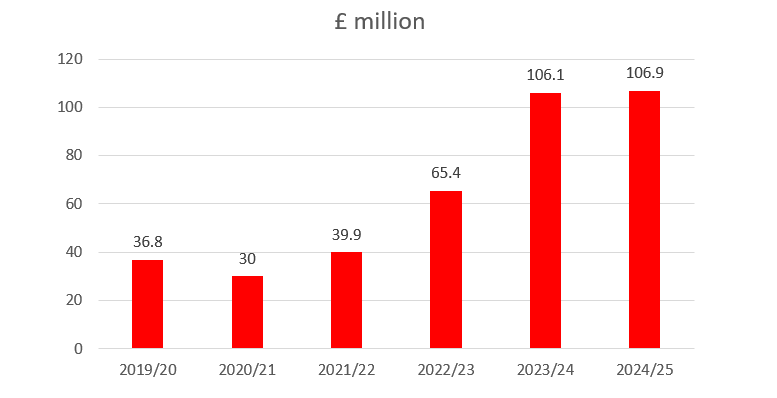
HMRC compliance yield from landlords
The Let Property Campaign (LPC), which was launched in the 2013/14 tax year, has brought in £570 million pounds in total from UK residential landlords. HMRC recovered £13,713 in tax per disclosure in 2024/25, by far the highest amount since the campaign’s inception.
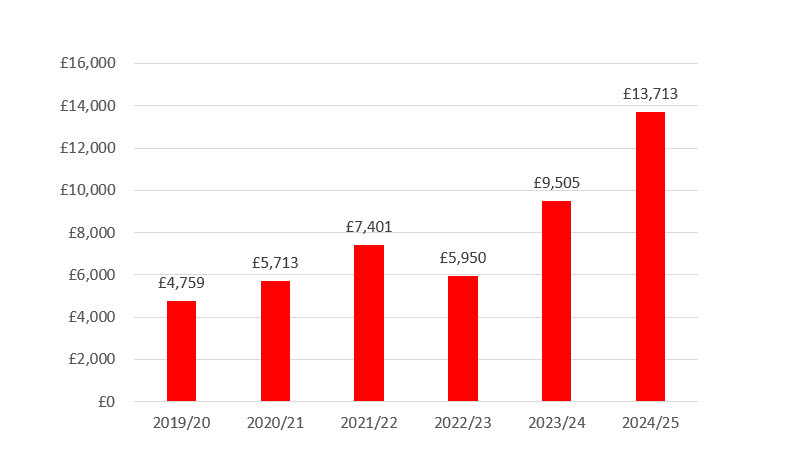
Yield per disclosure under the Let Property Campaign
The data released under the FoI represents tax recovered from voluntary disclosures under the LPC, and from other connected compliance related activities, such as HMRC’s non-responder and discovery assessment work.
According to the Ministry of Housing, Communities & Local Government, there were about 2.2 million UK private landlords in the first quarter of 2024 (most recent estimate). There have been 100,332 disclosures so far under the LPC, representing just over four percent of the total population of UK landlords.
Speaking to the Telegraph, Andrew Park, Tax Investigations Partner at Price Bailey, commented:
We’ve assisted large numbers of landlords in making voluntary disclosures over the last few years – typically, after they’ve received an HMRC nudge letter.” He explained that there is, for instance, widespread confusion about the different tax treatment of capital expenditure and revenue expenditure. “Capital expenditure, such as installing a significantly upgraded kitchen, is not deductible against letting income, whereas repair and maintenance of an existing kitchen or a like-for-like replacement is deductible. That distinction can be grey around the edges and trips a lot of landlords up.
Often people are accidental landlords who kept a property after moving to cohabit with a new partner, inherited a property or temporarily moved abroad. Many are not financially sophisticated or in receipt of high levels of other income, haven’t properly understood their responsibilities and haven’t previously sought advice. It doesn’t help that many landlords have unexpected taxable profits on paper but only because tax law has now changed to ignore the full cost of debt servicing. This creates a “phantom profit” effect: landlords owe tax on deemed income that doesn’t economically exist.
The data serves to remind landlords that they should review their tax affairs carefully, especially if they have never sought advice or assumed no tax was due. In the event that omissions come to light it is never too late to make a voluntary disclosure to HMRC to mitigate the position.
What happened in August 2025
HMRC Initiatives and New Legislation
- New nudge letters targeting associated company arithmetic
In a campaign scheduled to run through until October 2025, HMRC has begun writing to companies it suspects of miscalculating their number of associated companies for Corporation Tax purposes, and resultantly claiming too much marginal relief.
HMRC is using two different letter types to test their comparative psychological effect on recipients – for instance, one is headed “Check . . .” and goes on to threaten a compliance check if ignored, and the other is headed “Please check . . .” and leaves the threat of investigation unspoken.
Copies of the alternative letters are available here:
This initiative further reflects the ever-increasing and imaginative breadth of HMRC’s use of “nudge letters” as well as HMRC’s increasingly sophisticated use of data from sources such as Companies House to trawl for potential anomalies. HMRC’s experimentation with language as a means of persuasion has been ongoing for c. 15 years, and the evolution of their “Jedi mind tricks” evidently still has some way to go.
- Self-serve time to pay extended to Simple Assessment debts
Should they need it, Agent Update 134 announces that taxpayers receiving Simple Assessment letters advising them of further liabilities payable within three months or by 31 January 2026 are now being given online access to set up payment plans.
To qualify, taxpayers must owe between £32 and £50,000 and not have any other payment plans in place with HMRC or have any other outstanding debts to HMRC.
Sums owed will, of course, be subject to HMRC’s newly increased and more punitive late payment interest set at Bank of England base plus 4%.
Notably, tax is not deducted at source from the UK State Pension and Simple Assessments are issued after the tax year to pensioners in the event that they receive more State Pension than their personal allowance and do not have other work or private pension income from which the tax can be taken under PAYE and are not otherwise filing tax returns. The surge in the State Pension under the “Triple Lock” and frozen personal allowances will result in huge numbers of impoverished pensioners getting a nasty shock through their letterbox in this regard. A few hundred pounds is a lot of money to somebody who doesn’t have any. So, it seems likely that HMRC has extended easy access to time to pay very much with this in mind.
Case Decisions
- Lexgreen Services v HMRC [2025] UKFTT 1019 (TC)
“This is a case about the meaning of life” – so begins the Judge’s decision in this case before the First-tier Tax Tribunal (“FTT”) . . .
More specifically, the case concerns whether a corporate settlor was liable for Inheritance Tax (“IHT”) upon the 10-year anniversary of the settlement of a remuneration trust in 2005 under the provisions of the S201(d) Inheritance Tax Act 1984 – that provision applying where
where: “. . . the transfer is made during the life of the settlor . . .”.
Acting for the Appellant, Michael Firth KC argued that the legislation does not and was not intended to encompass corporate settlors or else it would have been drafted differently – that IHT is fundamentally concerned with life and death, a company has no life force and cannot make a transfer during its life as a settlor – “life” should have its ordinary meaning i.e. the period between birth and death of a living thing. The Court disagreed and found that the company was a live company at all material times – had the parliamentary draftsman intended to exclude corporate settlors from the application of the provision and limit it to “natural settlors”, it would have been a simple matter to do so.
Why this matters
This case involves a Baxendale Walker promoted tax avoidance arrangement and was designated a lead case to determine the same issue for a group of other cases under appeal, which depend upon the same principle. Had the Court found in the Appellant’s favour, it would have had wider ramifications for those other appeals and for many other longstanding trust arrangements involving corporate settlors. Ultimately, although argued for the Appellant with flair, the purposive approach adopted by the Court and the outcome was always the most likely outcome. The Courts now place little reliance on literal interpretation and tend these days to have more of an eye on what they feel the Law should be, even if the legislation doesn’t always articulate it very well.
- Elsbury v Information Commissioner [2025] UKFTT 915 (GRC)
In this unusual case before the First-Tier Tribunal (General Regulatory Chamber) Information Rights (“GRC”), the Appellant sought to compel HMRC to comply with a Freedom of Information (“FoI”) request to provide details of whether HMRC uses artificial intelligence (“AI”) in deciding whether or not to accept claims Research & Development (“R&D”) tax credits. Have HMRC been using AI to determine whether a projects truly aimed to achieve advances in science or technology and overcome uncertainties that “competent professionals” cannot readily simply deduce. It would be understandable if HMRC had started to move in that direction, given how ill-equipped its officers are to conclude on matters of science and technology that don’t fall within their experience, training or intellectual grasp. However, the Appellant has major concerns that patterns show HMRC is both using AI and still coming to inappropriate generic conclusions.
HMRC had refused the FoI on the basis that it would prejudice the collection of tax, and the Information Commissioner – who was the Respondent here rather than HMRC – had found for HMRC. However, the GRC has now overturned this on the basis that the public interest in transparency outweighs HMRC’s objections. HMRC now has until 18 September 2025 to reveal the information.
Why this matters
This is a rare instance of HMRC’s refusal to provide FoI information being challenged in the courts and challenged successfully. It will be fascinating to have an insight into whether and how HMRC has been using AI in such a high-activity area of contentious tax when HMRC’s response is made public. The answers may raise further questions and concerns.
It is also hoped that this reminder that there are limits to HMRC’s ability to refuse FoI requests when it suits them will lead to a greater volume of FoI data being released across the board.
Other News and Announcements
- Rt Hon Angela Rayner – SDLT investigation
The news about the Secretary of State for Housing, Communities and Local Government has failed to pay the right amount of SDLT on a property transaction and is now under HMRC investigation, serves as a salutary lesson on how complicated tax can be and the need to both seek advice from suitably specialist professional advisors and provide them with all of the necessary relevant information.
As many news reports highlighted, failure to get the tax bill right, resulting from carelessness, can result in penalties of up to 30% of the unpaid tax plus punitive late payment interest. Less well publicised was the possibility that in some circumstances – seemingly not those relating to Ms Rayner – HMRC and the Courts can view any wilful negligence in failing to get proper advice for fear of what that advice might be (so-called “Nelsonian blindness”) to be deliberate wrongdoing which can attract much higher penalties still.
What happened in July 2025
In the July contentious tax bulletin, Andrew Park, Tax Investigations Partner at Price Bailey, provides an overview of the most recent and significant contentious tax news, legislative changes, updates, and relevant case decisions that occurred throughout the previous month.
HMRC initiatives and new legislation
-
HMRC’s transformation roadmap
HMRC published a new “roadmap” on 21 July 2025. Alongside other objectives like improving the so-called “customer experience”, a core central element of the roadmap is HMRC’s strategy for “closing the tax gap” i.e. reducing the amount of tax – currently estimated at c. £47bn – which is payable under the law but which goes uncollected.
HMRC plans to improve compliance by:
- making increasing use of digitisation and AI to gather and analyse data to pre-populate entries in returns, identify taxpayers who need to brought within the system and send even greater numbers of “nudge letters” to taxpayers who appear to be non-compliant;
- improving IT systems to enable better real-time reporting and communication;
- bringing in new legislation from April 2026 to make recruitment companies that use umbrella companies legally responsible for accounting for PAYE on workers’ pay;
- targeting rogue tax advisors with enhanced information gathering powers and sanctions;
- modernising systems and processes for debt collection;
- aiming to increase the number of criminal prosecutions by 20% over the next five years;
- launching the already announced new HMRC whistleblower reward scheme by late 2025;
- recruiting c. 400 people – including external tax professionals – to bolster HMRC Fraud investigation Service’s efforts to tackle serious offshore non-compliance by the wealthy.
Case decisions
-
Marlborough DP Ltd v HMRC [2025] EWCA Civ 796
This case heard by Court of Appeal revolved around a tax avoidance scheme involving a dental practice company, Marlborough DP Ltd (“MDPL”), and its sole director and owner, Dr Matthew Thomas. The company had paid nearly all its annual profits into an offshore Remuneration Trust (“RT”), which then loaned back matching amounts to Dr Thomas. The scheme – which had been designed by the infamous Paul Baxendale-Walker (aka Paul Chaplin) – aimed to secure a Corporation Tax deduction for the contributions and deliver untaxed cash to Dr Thomas as loans rather than employment earnings or shareholder dividends.
At the initial appeal to the First-Tier Tribunal (“FTT”) the FTT found for the company and Dr Thomas in treating the amounts paid into the trust as shareholder dividends rather than disguised remuneration assessable on Dr Thomas under either general earnings provisions of S62 Income Tax (Earnings and Pensions) Act 2003 (“ITEPA”) or the anti-avoidance provisions of S554 ITEPA – as introduced in Finance Act 2011. However, showing little confidence in its own decision the FTT concluded that were it wrong and the payments were instead taxable as remuneration the company would be able to take a Corporation Tax deduction in respect of said deemed remuneration.
HMRC duly appealed to the Upper Tribunal on the grounds that the FTT had erred in law in not treating the payments as remuneration either under S554 or instead under S62 and was wrong also in its conclusion that it would then follow that the company would be able to claim deductions against Corporation Tax. The Upper Tribunal found that:
- the FTT had erred in its reasoning in concluding that for S554 purposes the employment had to be part of the reason for the reward and causative rather than merely in connection with it – accordingly, the earnings were taxable on Dr Thomas as deemed remuneration;
- the FTT had made a correct evaluative decision that for S62 general earnings principles – for which the test was not the same as for S554 – that the payments were derived from the recipient’s shareholding rather than in his capacity as an employee;
- Corporation Tax deductions were not then available because the company failed the wholly and exclusively test because “. . . the intention of MDPL in making the contributions was to empty the company of profit in order to fund a tax-free benefit (i.e. the loans) to Dr Thomas. There was no trading purpose and no benefit to MDPL’s trade . . .”
The taxpayer then appealed to the Court of Appeal on the grounds that:
- The UT applied the wrong test when determining whether the loans were “in connection with A’s employment”, for the purposes of Part 7A.
- The UT erred in failing to consider whether the connection identified was displaced and/or applied the wrong approach to that question.
- The UT erred in failing to explain why that connection amounted to a “strong and direct” connection and erred in failing to properly apply its test and reaching an unsustainable conclusion.
- The UT erred in failing to consider whether the arrangement was a means of providing payments with that connection.
- The UT erred in overturning the FTT’s conclusion on corporation tax as it identified no error of law in the conclusion that the tax advantage was not an end in its own right. If Ground 4 above does not succeed, the UT must still have found that the alleged connection with the employment of Dr Thomas was essentially the arrangement’s trading purpose.
The Court of Appeal rejected all the grounds of appeal and upheld the Upper Tribunal’s decision – including, crucially, the reasoning that for the purposes of S554 ITEPA 2003 a causal test of “in connection with” is not required – a sufficient connection, direct or strong, will satisfy the condition even if employment was not the reason for the payment or loan.
Why this matters
The substance of this situation is surely clear in that Dr Roberts was only in a position to procure the transfer of all of the company’s profits for the year to a Remuneration Trust arrangement because he was the company owner rather than merely it’s director. The arrangement surely only makes sense in substance as a disguised distribution rather than disguised remuneration. However, for the purposes of the disguised remuneration provisions at S554 ITEPA 2003, the legislation is now shown to be widely enough drawn for a strong connection with employment to be enough – as in circumstances like these, where an arrangement was effected by someone as director on behalf of themselves as shareholder.
More broadly, the decision is likely to be used as authority in other areas of taxation where an “in connection with” test applies and to be generally of more assistance to HMRC than to the taxpayer.
Other news and announcements
-
HMRC annual report and accounts 2024 to 2025
Published on 17 July 2025, the latest HMRC annual report contains a wealth of information including:
- there were 446 new criminal investigations as well as 310 criminal prosecutions during the year with a 91% conviction rate;
- there were 11,000 new civil investigations into suspected fraud (the vast majority not under COP 9);
- HMRC are recruiting an additional c. 5,500 tax officers to focus on tax enforcement;
- HMRC’s crackdown on renegade tax advisors resulted in 1,285 advisors being blocked access to HMRC services and 183 of them coming under investigation themselves;
- error and fraud in R&D tax relief claims continues to fall but is still believed to be high at c. 10% of the amounts being claimed;
- a record 46,266 penalties – predominantly late filing penalties – were successfully appealed – commenting in The Telegraph Andrew Park, of Price Bailey, said “banking delays, administrative failings by HMRC, and poor customer service were all factors that led to taxpayers filing late. Late filing penalties are disproportionately levied on people on low incomes, many of whom have no tax to pay”.
What happened in June 2025
HMRC initiatives and new legislation
-
One-to-many letters targeting “persons with significant control” and directors who have had company loans written off
HMRC has issued a new round of “nudge letters” to people believed from Companies House filings to exercise significant control over companies – typically because they’re 25%+ shareholders – questioning whether they should have filed personal Self Assessment tax returns for 2023/24 or, alternatively, whether their filed tax returns for 2023/24 correctly reflect all related income, benefits and capital gains.
The letters seek action to file any outstanding returns or correct errors in submitted returns by 25 July 2025.
Copies of the HMRC letters are available here:
Person with significant control – about registering for Self Assessment
Person with significant control – making sure your Self Assessment tax
Separately, HMRC has begun writing to company directors who are believed to have had company loans written off between April 2019 and April 2023, asking why these write-offs were not declared on their personal Self-Assessment tax returns as personal income assessable to Income Tax.
Case decisions
-
Osmond v HMRC [2025] UKUT 183 (TCC)
In this case—initially found in HMRC’s favour by the First-Tier Tribunal (FTT) and later appealed to the Upper Tribunal—HMRC sought to deny Capital Gains Tax (CGT) treatment, including EIS CGT relief, by applying the Transactions in Securities (TiS) anti-avoidance rules under the Income Tax Act 2007. The TiS rules exist to prevent taxpayers from disguising income receipts as capital in order to pay lower rates of tax.
The taxpayers had invested in a company – Xercise Ltd – with the intention from the outset that the future disposal of their investments would qualify for EIS relief. As a result of a share for share restructuring in 2009 they became shareholders in a successor company – Xercise2 Ltd. Ultimately, in 2015 they exited their investments through a share buy back by Xercise 2 Ltd which enabled them to retain their entitlement to EIS relief.
HMRC argued that the buyback was caught by the TiS rules because it failed the main purpose test at S687 ITA 2007 of having an Income Tax advantage. This persuaded the FTT, but the Upper Tribunal then found that the FTT had erred in law:
- obtaining CGT relief under EIS does not automatically equate to seeking an Income Tax advantage;
- it is the subjective intention of the taxpayers that matters and achieving CGT relief does not necessarily imply an Income Tax motive – the effect of the transaction was to achieve an Income Tax advantage but that was not the main motive for it.
Why this matters
This was surely attempted HMRC overreach. In turn, the original FTT decision against the taxpayers was troubling and stood to have serious ramifications in undermining the whole EIS regime – under which Parliament purposely offers favourable tax treatment – in order to incentivise and reward investment in small, high-risk companies. The appellants only made the original investments in the expectation of receiving EIS relief when they exited, and of course they were not going to throw that away by e.g. instead extracting value through dividends.
It never followed that it was the intention of Parliament for the TiS anti-avoidance rules to disapply the availability of EIS, and the Upper Tribunal’s confirmation that they do not, is most welcome.
-
BGC Services Holdings LLP v HMRC [2025] UKFTT 700 (TC)
On 9 June 2025 the FTT refused HMRC permission to appeal two earlier case management decisions relating to Regulation 80 Income Tax determinations issued by HMRC. These totalled c. £96m for the tax years 2017/18 to 2019/20 under the Salaried Members Rules – which deem certain LLP members to be employees for tax purposes.
The partnership has appealed the determinations on the basis that they do not particularise why HMRC concluded that additional tax was due, and because they considered no additional tax was in fact due.
Procedurally, the FTT has refused a request by HMRC for further and better particulars from the appellant, and has instead required HMRC to particularise in its statement of case how salaried members conditions were met for specific partners, how the tax was calculated and the basis for alleging deliberate or careless behaviour on the part of the taxpayer.
The Tribunal found that HMRC’s failure to provide reasons for the determinations is a breach of HMRC’s public law duties – even though there is no statutory requirement to give reasons. In doing so, the Tribunal has emphasised the importance of transparency and procedural fairness in tax administration and has criticised HMRC’s handling of the case.
Why this matters
Although it remains to be seen whether HMRC will now successfully seek permission directly from the Upper Tribunal to hear their appeal on the case management decisions, ultimate success in that regard seems unlikely and, that being so, HMRC will now need to state their case in the detail which commonsense, fairness and normal practice always suggested was required.
The case serves as a reminder of HMRC’s propensity at times to try to test the boundaries and the importance of fiercely contesting such attempts. HMRC had sought to sidestep its obligations by arguing that the burden was on the taxpayer to address the detail of the matter, but Judge Redston had little truck with that stating:
. . where HMRC have failed to give reasons, they cannot simply rely on the burden of proof and require the Appellant to provide F&B [further and better] particulars to “colour in the detail” of HMRC’s own decision. Moreover . . . the burden of showing that this was the case rests on HMRC . . . it is for HMRC to show that they have “fairly consider[ed] all material placed before them and, on that material, come to a decision which is one which is reasonable and not arbitrary as to the amount of tax that is due” . . . It is only when they have done so that “the burden passes to the taxpayer to establish on the balance of probabilities that the assessment is excessive.
Other news and announcements
-
Measuring tax gap estimates published for 2023/24
Released on 19 June 2025, HMRC’s latest estimates are that:
- the overall level of unrecovered tax stands at 5.3% of theoretical total tax liabilities;
- the tax gap is most pronounced for Corporation Tax at 15.8% – compared to only 3% for Income Tax / National Insurance / Capital Gains Tax;
- 40% of the total tax gap is made up of Corporation Tax but Income Tax / National Insurance / Capital Gains Tax still make up 30% because of the greater scale of personal taxes payable;
- small businesses are responsible for 60% of the total tax gap compared with only 5% for wealthy individuals.
Behaviourally, lost taxes relate:
- 31% to failure to take reasonable care;
- 15% to other error;
- 14% to tax evasion;
- 12% to alternative legal interpretation;
- 12% to non-payment of determined debts;
- 9% to criminal attacks;
- 5% to the hidden economy;
- only 1% to misconstrued tax avoidance.
There are no major surprises in the estimates compared to last year and the main concern continues that Britain’s c. 5.5m small businesses are responsible for the lion’s share of the tax gap and there’s little sign of HMRC being able to introduce effective new measures to address the issue. Inevitably smaller businesses are both more prone to making inadvertent errors because they have less internal accounting expertise and less resource to spend on external advice but are also more prone to deliberate understatements or overly optimistic accounting treatments because they tend to be actively owner managed.
Although “Making Tax Digital” is one imagined partial solution to addressing small business compliance how effective that will really prove is uncertain. HMRC will have little alternative for the foreseeable future other than to direct more and more resources into opening more and more investigations into smaller businesses.
What happened in May 2025
HMRC initiatives and new legislation
-
New HMRC letter campaign to mail order and internet retail companies warning against unscrupulous R&D boutiques
HMRC have begun mass mailing mail order and internet retail companies, warning them that their sector is being targeted by unscrupulous R&D agents trying to encourage firms to make unsupportable claims for R&D tax relief. HMRC warns that advances in the field of science and technology are unusual in their industry and that “no win, no fee” is not no risk.
Invalid claims risk inaccuracy penalties and punitive late payment interest – not to mention significant professional costs and disruption in rectifying.
HMRC advises companies to speak to their normal Corporation Tax agents before engaging the services of a separate R&D agent.
As with so many HMRC education letters, as well as seeking to prevent future non-compliance, the letters also serve a further purpose in strengthening HMRC’s ability to levy higher penalties on companies that still go ahead in pursuing invalid claims through rogue agents after HMRC have warned them.
A copy of the standard HMRC letter can be viewed here:
Claims for R&D tax relief final letter
Case decisions
-
Realbuzz Group Ltd v HMRC [2025] UKFTT 00493 (TC)
In this appeal before the First-Tier Tribunal (“FTT”), the appellant company had submitted claims for R&D relief. HMRC opened an enquiry into the Corporation Tax return for year ending 30 April 2021 and ultimately closed the enquiry after finding that the R&D claim for that year was invalid in its entirety.
The company had also made prior year R&D claims, which HMRC deemed invalid. As HMRC was outside the 12-month window to open an enquiry into the year ended 30 April 2020, they issued a discovery assessment to disallow the claim instead.
The company appealed solely on the basis that HMRC was not entitled to raise the discovery assessment – not because HMRC’s conclusion was incorrect, but because an officer “could have been reasonably expected, on the basis of the information made available to him, to have been aware [of the excessive relief] before he ceased to be entitled to give notice of enquiry” into the return for APE 2020. This is a statutory protection at Schedule 18 to the Finance Act 1998 at Paragraph 44:
“44 (1) A discovery assessment for an accounting period for which the company has delivered a company tax return, or a discovery determination, may be made if at the time when [an officer of Revenue and Customs]—
(a) ceased to be entitled to give a notice of enquiry into the return, … [he] could not have been reasonably expected, on the basis of the information made available to [him] before that time, to be aware of the situation mentioned in paragraph 41(1) or (2). (2) For this purpose information is regarded as made available to [an officer of Revenue and Customs] if— (a) it is contained in a relevant return by the company or in documents accompanying any such return, or
(b) it is contained in a relevant claim made by the company or in any accounts, statements or documents accompanying any such claim, or
(c) it is contained in any documents, accounts or information produced or provided by the company to [an officer of Revenue and Customs] for the purposes of an enquiry into any such return or claim, or
(d) it is information the existence of which, and the relevance of which as regards the situation mentioned in paragraph 41(1) or
(2)—
(i) could reasonably be expected to be inferred by [an officer of Revenue and Customs] from information falling within paragraphs (a) to (c) above, or
(ii) are notified in writing to [an officer of Revenue and Customs] by the company or a person acting on its behalf.
During the time that the enquiry window was open for APE 2020, HMRC had been provided with a detailed report by the company setting out the basis for the claim, and the Court concluded that the actual officers who made the decision to raise the discovery assessments relied upon the information in that report.
It therefore followed that the information necessary was already there in HMRC’s possession for “hypothetical officers” to be reasonably expected to be aware of an insufficiency of tax within the APE 2020 enquiry window.
The later report provided by the company for APE 2021 was not found to be further information that was clearly relevant or necessary with regard to any insufficiency of tax for APE 2020.
The Court found for the taxpayer that HMRC had missed its opportunity to amend the APE 2020 return by opening an enquiry when it had all necessary information and, as such, HMRC was barred from “getting a second bite of the cherry” by making a later discovery assessment.
Why this matters
On one level, the case merely serves as an assertion of the legal position that is plainly set out in the statute – if perhaps too often overlooked by advisers or regarded as a battle not worth fighting, because in most circumstances, the Courts readily lean towards HMRC in giving them broad latitude to argue that HMRC did not have all necessary information to spot an insufficiency of tax within the enquiry window.
However, this case is significant because it points to a common scenario involving R&D claims where taxpayers can successfully argue the point because their claims are frequently supported by a wealth of information contemporaneously submitted at the outset in support of the claims rather than dragged out of taxpayers at a later date when under investigation.
All companies and their advisers who are presently in the midst of multi-year tax disputes with HMRC over R&D claims – which normally initiate with a statutory enquiry into the latest year – should take close heed of whether this case mirrors their own circumstances. Moreover, the case highlights the protective value against later discovery assessments of providing HMRC with full detailed information when making R&D claims, or indeed, other claims more generally.
Other news and announcements
-
HMRC briefing note published on the latest independent review of the disguised remuneration loan charge
The briefing note published by HMRC on 22 May 2025 explains HMRC’s actions whilst the review is ongoing. It explains that HMRC has now finished sending letters and a “question and answer” document to taxpayers to:
- give them a named HMRC contact;
- set out whether HMRC think the disguised remuneration arrangements they used will be considered by the review or not, and explain what HMRC’s operational approach to customers will be in their case during the review.
HMRC has sent four different categories of letter to taxpayers depending on their current circumstances – comprising letters regarding:
- mixed disguised remuneration arrangements – considered by the review;
- disguised remuneration arrangements – considered by the review;
- settled disguised remuneration arrangements – considered by the review;
- disguised remuneration arrangements – not considered by the review.
HMRC stress that they won’t be able to tell taxpayers exactly how they may be affected until both the review is complete and the findings are published and the Government issues its response to any review recommendations.
Unfortunately, the terms of reference of the new review are limited to recommending new ways to help or induce taxpayers who are caught by the legislation to settle if they have not done so. There is no prospect of the new review recommending that the legislation should be further revised to take more taxpayers out of its scope or to reduce their liabilities.
What happened in April 2025
-
Nudge letter campaign targeting private security businesses
HMRC has written to businesses providing security workers, urging them to check they are paying tax appropriately. HMRC considers this should ordinarily be through registration for PAYE Income Tax and National Insurance deductions.
HMRC has identified a particular risk due to the number of unscrupulous and criminal elements it says are now operating within the sector.
In many cases, care will need to be taken to confirm which business in a supply chain – that may include agencies or recruitment companies – is responsible for operating PAYE, and whether they are actually doing so.
Any remedial action should be taken by 2 August 2025.
A copy of the standard HMRC letter can be viewed here:
Case decisions
-
George Mantides Ltd v HMRC [2025] UKUT 00124 (TCC)
The appellant, a urologist, provided locum services through his personal services company to Royal Berkshire Hospital and Medway Maritime Hospital in 2013.
The main issue was whether the income received by the company for these services was subject to Income Tax and National Insurance contributions under the IR35 employment status legislation. The First-tier Tribunal (FTT) initially ruled that the services provided to Medway Maritime did not constitute employment, but those provided to Royal Berkshire did. This was on the basis of three material differences between the hypothetical contracts with Medway Maritime and Royal Berkshire:
- Right to substitute: The Medway Maritime contract allowed the appellant to send a substitute if approved by the agency, which pointed away from employment.
- Notice period: The Medway Maritime contract could be terminated on one day’s notice, which is almost illusory and does not point to employment.
- Obligation to provide work: The Medway Maritime contract contained no obligation on Medway Maritime to provide, or try to provide, any sessions in a week, which pointed away from employment.
The Upper Tribunal found that the FTT made errors of law in its findings regarding the hypothetical contract between the appellant and Royal Berkshire. Specifically, the FTT incorrectly concluded that an inferred contract required a week’s notice for termination and that Royal Berkshire was obligated to provide 10 half-day sessions per week. Those terms were not found to have been supported by the evidence before the FTT and those errors led the Upper Tribunal to set aside the FTT’s decision and remake it.
However, in remaking the FTT decision, the Upper Tribunal still found against the appellant because, for several reasons, it still concluded that there was an implied contract between the appellant and Royal Berkshire:
- Personal service: The Upper Tribunal found that the hypothetical contract would require the appellant to provide his own work and skill, indicating a contract for personal service, which is a pointer towards employment.
- Control: The Upper Tribunal noted that the appellant would be subject to a measure of control by the hospital. This included being obliged to conduct sessions as specified in the rota and dealing with patients on the list, which pointed towards employment.
- Mutuality of obligation: The Upper Tribunal concluded that there would be sufficient mutuality of obligation to satisfy this condition. This means there would be an obligation to work and an obligation to pay for the work done.
- Terms of the hypothetical contract: The Upper Tribunal outlined the terms of the hypothetical contract, which included that it would be for a fixed term, terminable early by either party without notice, and for the personal services of the appellant to work as a urologist.
Why this matters
All employment status cases turn on their own facts, but there are doubtless countless medical practitioners who have provided their services in very similar ways to the arrangements between Mr Mantides and Royal Berkshire who were willing him on to win his appeal and now have ongoing concern over their own tax positions.
The Upper Tribunal took several years to conclude on this appeal because it deferred Judgement pending the outcome of HMRC v Professional Game Match Officials Limited [2024] UKSC 29 by the Supreme Court and whether that would have a bearing on the hypothetical employment contract before them. In the end, it did, and the FTT’s errors could have resulted in a different decision – which is why the Upper Tribunal decided to remake the decision – albeit still not in the taxpayer’s favour after an ordeal of litigation lasting some 12 years.
-
Christian Peter Candy v HMRC [2025] UKFTT 00416 (TC)
This case revolved around a claim for repayment of Stamp Duty Land Tax (SDLT) made under Paragraph 34, Schedule 10, Finance Act 2003.
The appellant sought repayment of £1,920,000 in SDLT paid on substantial performance of a contract for the assignment of a lease for Gordon House in Chelsea. The claim was initially refused by HMRC in a closure notice dated 13 August 2015, leading to an appeal to the FTT.
The core issue was whether relief under Para 34 could be claimed in a situation where SDLT would have been repayable under s 44(9) FA 03, notwithstanding that the claimant could evidently not do so because he was out of time to amend the land transaction return within the necessary 12-month time limit. The Court determined that Para 34 provides a “back-stop” for SDLT relief independent of s 44(9), allowing the appeal and granting relief to the appellant.
The Court’s decision was based on the interpretation that Para 34 is designed to provide a final statutory remedy when no other such remedy exists, acting as a last resort or back-stop where all other statutory relief provisions have been exhausted.
There is nothing profound in the decision and which was simply based upon:
- Legislative wording and structure: The Court examined the wording of Para 34 and its interaction with other statutory provisions. Para 34 is designed to provide relief where tax has been overpaid and no other statutory remedy is available. This is evident from the broad application of Para 34 once its threshold provisions are met and its procedural requirements satisfied.
- Case C in Para 34A: The Court noted that the wording of Case C in Para 34A(4) supports the interpretation that Para 34 operates as a backstop. Case C precludes relief under Para 34 where the claimant could have sought relief by taking other steps within a period that has now expired and knew, or ought reasonably to have known, that such relief was available.
- Explanatory notes and technical note: The Court referred to the explanatory notes to the Finance (No.2) Bill 2010 and a HMRC Technical Note – “Relief for mistakes in Stamp Duty Land Tax Returns – draft legislation”, which confirmed that Para 34 was intended to provide a right to repayment in situations where no other means of reclaiming the overpayment existed. The explanatory notes and technical note highlighted the policy aim of Para 34 to limit the alternative necessity for common law restitution claims through the High Court, and to provide a consistent and comprehensive statutory scheme for the recovery of overpayments.
- Previous case law: The Court considered previous case law, such as the FTT decision in Derek and Susan Smallman v HMRC, which held that Para 34 was indeed a backstop allowing taxpayers to claim relief for overpaid SDLT in circumstances where they were out of time to make a claim under s 44(9).
- Statutory interpretation: The Court emphasised the importance of discerning and giving effect to the meaning of the words used by Parliament. The Court’s task was to ascertain and give effect to Parliament’s purpose, which was to provide a final statutory remedy when no other such remedy exists.
Why this matters
It is very hard in this case to understand how the FTT could ever possibly have come to any other conclusion and, indeed, what motivated HMRC to try to advance such an apparently ungrounded, illogical and unfair position – except, perhaps, out of a general ill disposition, for whatever reason, towards the taxpayer in question.
However, were HMRC to have succeeded it would have dramatically reduced the scope for taxpayers to make claims for overpaid tax in situations of conspicuous unfairness, not just for SDLT, but for other taxes for which the same framework applies – including Income Tax, CGT and Corporation Tax.
Other news and announcements
-
Late payment interest increased to base rate plus 4%
Further to an initial announcement in the Chancellor’s October 2024 Budget speech, HMRC’s statutory late payment interest was ramped up to Bank of England base rate plus 4% from April 2025. It was previously levied at base rate plus 2.5%.
The change marks an overt departure from the original neutral principle that people and companies owing tax should not gain a financial benefit from doing so, to now becoming a further form of punishment on top of HMRC’s substantial existing penalties.
Unlike existing forms of penalty, there is no formal appeal process against late payment interest whereby taxpayers can claim they are not culpable as they have a reasonable excuse. It therefore appears ripe for legal challenge on Human Rights or other grounds. In the meantime, HMRC appear to have realised that there is a potential issue here and we are already seeing more instances of HMRC offering to waive late payment interest at their own discretion where HMRC’s own conduct is a factor in taxpayers not being able to confirm and settle outstanding liabilities.
Conversely, HMRC now typically takes months to process repayment claims whilst only being obliged to pay interest on money owed to taxpayers at a dismal base rate minus 1%…
What happened in March 2025
HMRC initiatives and new legislation
-
HMRC giving electronic till suppression evaders one last chance to come clean
Tax fraud through understating business takings going through the tills is as old as the cash register, but it has become much harder since the advent of electronic tills producing automatically generated sales records. Spotting an opportunity, many unscrupulous software developers have targeted businesses throughout the world with special software designed to artificially suppress sales recorded by electronic tills so the businesses concerned can understate their takings without being caught out by an HMRC audit.
HMRC now has a growing mass of intelligence from a coordinated international law enforcement effort against software providers around the world and has been systematically contacting businesses which appear to have bought illicit software to investigate them or urge them to come clean by making a voluntary disclosure.
The latest letters being issued by HMRC state they are giving the recipients a “final opportunity to make a complete, accurate and honest disclosure before we calculate what we think you owe and charge penalties on top”.
An example letter is available here:
Although, previous “nudge letters” to businesses suspected by HMRC are sometimes known to have been sent to businesses which have not actually conducted the frauds suspected, it seems that many businesses have operated fraudulently and have resisted attempts to make them come clean – notwithstanding maximum civil penalties of up to 100% of the outstanding tax in situations where they have concealed the fraud with the creation of a fake record trail – or else possible criminal prosecution.
For its part, it seems that HMRC has had to resort to repeated “nudging” for lack of resource to open investigations into all the businesses that it suspects – which seems to be undermining its deterrence effort. Of course, if HMRC does want to calculate and assess the additional tax it thinks it is owed, it can do so going back up to 20 years for tax fraud but cannot do so without engaging in investigative work and opening current year enquiries or raising discovery assessments for earlier years – then forcing them to engage with HMRC to demonstrate the suspicions are unfounded or mitigate their position.
A business that comes under investigation or wishes to make a voluntary disclosure should seek urgent specialist professional advice. Acceptance into HMRC’S Code of Practice 9 Contractual Disclosure Facility will guarantee the individuals involved that they will not be personally criminally prosecuted but that is in return for full cooperation and full disclosure throughout the process. The process should not be entered into lightly or without total commitment.
Case decisions
-
HMRC v Bolt Services UK Limited v HMRC [2025] UKUT 00100 (TCC)
This case revolves around the application or otherwise of the Tour Operators’ Margin Scheme (“TOMS”) to VAT on mobile ride-hailing services. The successful application of TOMS would result in VAT only being chargeable on the commission element charged by the appellant company to the private hire vehicle operators – who are independent contractors – rather than the whole fare charged to the passenger.
The company requested a non-statutory ruling from HMRC regarding the VAT treatment of its on-demand ride-hailing services. HMRC ruled that these services did not fall within TOMS, leading the company to appeal to the First-tier Tribunal (“FTT”) – which ruled in its favour. HMRC then appealed to the Upper Tribunal.
In coming to its conclusions, the Upper Tribunal considered two main issues:
- Whether Bolt’s services were of a kind commonly provided by tour operators or travel agents.
- Whether Bolt supplied the services of the drivers to the passengers without material alteration or further processing.
The Upper Tribunal concurred that the company’s services did fall within TOMS and dismissed HMRC’s appeal against the FTT’s decision. It concluded that:
- Bolt’s ride-hailing services are comparable to services provided by tour operators or travel agents, as they involve passenger transport, which is a travel service –whether they be point-to-point journeys via apps, airport transfers or station drop-offs.
- The services provided by Bolt were not materially altered or processed and were supplied for the direct benefit of the traveller.
The Judge emphasised that the scope of TOMS should be interpreted broadly to avoid distortion of competition and ensure uniform application of VAT rules.
Why this matters
Bolt’s business model is not unique and is shared by other ride-hailing companies – including Uber and FREENOW – who now collectively account for billions of pounds in passenger fares. Consequently, if this decision stands HMRC will likely have to reimburse well over £1bn in VAT to Uber alone at a time of significant pressure on the public purse.
Given the vast amount of tax involved it is almost certain that HMRC will seek permission to take the case to the Court of Appeal. It is also highly likely that the Government will introduce new legislation to ensure that regardless of the past position the full value of any taxi fare mediated by a ride-hailing service will fall squarely subject to VAT in future.
Other news and announcements
-
Chancellor’s Spring Statement – 26 March 2025
Further to the Government’s ongoing policy objective to Close the Tax Gap and the Chancellor announced a raft of further measures and proposals to improve tax compliance and increase punishments for non-compliance :
- Investing in HMRC’s debt management capacity: The Government will invest in HMRC’s debt management capacity, including recruiting 500 more compliance staff and expanding partnerships with private sector debt collection agencies.
- Making Tax Digital (“MTD”): The continued rollout of MTD with its quarterly reporting for Income Tax Self Assessment (“ITSA”) will include sole traders and landlords with qualifying income over £20,000 who will be required to join from April 2028. The aim is to make it easier for taxpayers to pay the right tax without less cope for error through a modernised and digital tax system.
- Increasing late payment penalties: Late payment penalties for VAT taxpayers and ITSA taxpayers will be increased as they join MTD from April 2025 onwards beyond the level of penalties originally envisaged.
- Consultation proposals: The Government is publishing consultations on how HMRC can make better use of third-party data, proposals to strengthen HMRC’s ability to take action against tax advisers who facilitate non-compliance, measures to close in on promoters of marketed tax avoidance, and options to simplify and strengthen HMRC’s inaccuracy and failure to notify penalties.
- Prosecuting more people for tax fraud: HMRC is expanding its counter-fraud capability with a view to increasing the number of annual charging decisions by 20%, from 500 to 600 per year by 2029-30.
- Reforming rewards for informants: A new HMRC reward scheme for informants will be launched later in 2025, targeting serious non-compliance by large corporates, wealthy individuals, offshore and avoidance schemes.
- Tackling “phoenixism”: HMRC, Companies House, and the Insolvency Service are delivering a joint plan to tackle those using contrived insolvencies to evade tax and write off debts owed to others.
- Overhauling offshore tax non-compliance: HMRC will recruit experts in private sector wealth management and deploy AI and advanced analytics in an effort to help identify and challenge failed offshore arrangements. Another 400 dedicated staff will be recruited – likely many of them will sit within HMRC FIS Offshore Corporate and Wealthy and will conduct an increased number of COP 8 investigations.
Collectively, the measures aim to raise over £1 billion in additional gross tax revenue per year by 2029-30. However, they are not all without controversy – particularly, the forthcoming whistleblower programme . . .
-
New US-style whistleblower programme
The Spring Statement confirmation that the programme will be launched in later 2025 followed on heels of a speech by Treasury Minister James Murray on 11 March 2025.
The new reward scheme is aimed at incentivising informants to expose failed tax avoidance as well as fraud among wealthy individuals and multinational businesses. Under the scheme, The Times has reported that whistleblowers could receive up to 25% of the additional tax revenue raised as a result of their reporting.
A Price Bailey Freedom of Information request shows that in 2023/24, the Treasury paid out £978,256 under its existing informant scheme, although the number of recipients and the total additional tax revenue raised from those reports was not disclosed. The new scheme is inspired by the US model, where detailed public reporting shows that the US Internal Revenue Service (“IRS”) paid $89 million (£68 million) to 121 whistleblowers in the 2022/23 fiscal year, resulting in an additional $338 million (£261 million) in tax collected.
Speaking to The Times Political Editor, Andrew Park, Tax Investigations Partner at Price Bailey said:
In comparison terms, the level of rewards offered by HMRC is minuscule compared with the IRS. The thing with very large frauds is that the people in a position to report them tend to be in quite involved positions.
They need a pretty major incentive to blow the whistle, even with HMRC’s guarantees of anonymity. They are taking a risk and they want to feel that they are going to be rewarded and protected. The US scheme proves that significant amounts of money can be raised by paying informants.
Under the current system, HMRC gets swamped with vexatious, low-level reports. It hasn’t provided enough of an incentive for the really major frauds. Some of these cases involve criminal gangs and people could be at physical risk if they blow the whistle.
Ministers are understood to be considering payments of between 10% and 25% of the extra tax collected under the new scheme.
However, as understandable as the new programme is on the part of HMRC, aspects of it are likely to prove highly controversial and/or subject to legal challenge. Not everything about the American modus operandi will necessarily translate easily from the US to the UK.
Inevitably, the sort of people best placed to blow the whistle on tax irregularities will often have been complicit themselves and will often require immunity from prosecution in addition to receiving lottery win financial payouts for something they had a hand in. Moreover, the incentives will likely spur people to steal confidential information and perhaps even to join companies seeking to investigate them from the inside. Any thefts of confidential data from within professional firms and financial institutions would be controversial – particularly were it to come from within UK law firms. Albeit, there are existing precedents in HMRC’s previous use of massive amounts of data stolen from overseas law firms, overseas trust companies and overseas banks. The devil will be in the detail of the implementation.
Any businesses or wealthy individuals with any concerns at all that they might not be fully tax compliant, and might shortly be seen as a lucrative target by a potential whistleblower, should double-down on their compliance efforts and revisit any old professional advice to ensure it is sound. In the event anything needs drawn to HMRC’s attention, it is never too late to pre-emptively address and mitigate the situation by voluntary disclosure if HMRC has not already formally opened an investigation.
What happened in February 2025
- HMRC initiatives and new legislation
-
Nudge letters to offshore companies holding UK residential property
HMRC have launched a new campaign targeting overseas companies which they know from HM Land Registry to own UK residential property, but which did not pay the UK’S Annual Tax on Enveloped Dwellings (“ATED”) in the three years to 2019/20. This being either without the companies filing ATED returns or because they have filed ATED returns and have claimed exemption from ATED on the basis that they have met the qualifying criteria for letting relief.
HMRC’s main focus is on the concern that many overseas companies not paying ATED may have allowed “non-qualifying” connected individuals to occupy the properties – as suggested, in many cases, by them filing Non-Resident Landlord Income Tax returns reporting their properties were persistently let at a loss.
The letters come in different forms depending on whether or not the companies filed any ATED returns during the period. The letters may nudge the recipients to review their position and make voluntary disclosures if required or the letters may come with a request for detailed information about the letting and occupancy of the properties for HMRC to verify the position for itself.
- OTM Final Letter (Non relief filer – no agent) – OTM000384
- OTM Final Letter (Relief filer – no agent) – OTM000384
- Encompassing Schedule (Final) – OTM000384
-
HMRC targeting individuals involved in online sales during the year to 5 April 2023
Further to the closure of the tax return amendment window for 2022/23 returns on 31 January 2025, HMRC is now targeting individuals suspected of undisclosed trading using online sales platforms to nudge them into making voluntary disclosures through the Digital Disclosure Service.
HMRC now obtains a huge amount of bulk data from popular online platforms and filters through it as a matter of routine to cross-compare it with the tax records of platform customers.
Inevitably, many people receiving letters will not have been conducting a main trade or taxable “side hustle” and in light of previous publicity around this topic and previous inadvertent misinformation in the media, the latest letters emphasise that using online platforms to dispose of personal goods is not trading and will not give rise to tax liabilities unless capital gains are realised in excess of annual allowances.
Case decisions
-
A Taxpayer v HMRC [2025] EWCA Civ 106
In this long running case now brought from the Upper Tribunal to the Court of Appeal, HMRC contended that the appellant taxpayer was resident in the UK for the purposes of UK Income Tax in the tax year 2015/16. The appellant received £8m in dividends in that year but claimed she was not taxable in the UK as she had become resident in the Republic of Ireland. The issue revolves around the application of the Statutory Residence Test (“STT”) contained in Schedule 45 to the Finance Act 2013.
The First-tier Tribunal (“FTT”) initially allowed the appellant’s appeal, finding that there were exceptional circumstances on six days in question, which prevented her from leaving the UK and staying within the normal non-residence day count permitted to her under the SST. However, the Upper Tribunal set aside the FTT’s decision, holding that there were no exceptional circumstances – the appellant had an alcoholic sister and there were issues with the care and safeguarding of her children but such circumstances were held to be all too common and not exceptional for SST purposes. The appellant then appealed to the Court of Appeal, seeking to have the FTT’s decision restored.
There were five contested grounds of appeal (ignoring a sixth contingent one which was disregarded by mutual consent):
- The Upper Tribunal erred in its approach to the test as to whether the appellant was “prevented” from leaving the UK.
- The Upper Tribunal erred in holding that whether circumstances were “exceptional” was a matter of law.
- The Upper Tribunal erred in holding that moral obligations cannot be or cannot be part of the exceptional circumstances.
- The Upper Tribunal erred in holding that the First-tier Tribunal (FTT) made contradictory findings on the “exceptional circumstances” issue.
- The Upper Tribunal erred in holding that the FTT had no evidence to support their finding that the paragraph 22(4) conditions were met on each day.
The Court of Appeal, after considering the arguments from both sides, preferred the submissions of the appellant’s Counsel and allowed the appeal on all grounds, restoring the decision of the FTT. The Court concluded that the circumstances, including the need to care for the appellant’s twin sister and her minor children did indeed constitute exceptional circumstances that prevented her from leaving the UK.
Why this matters
The decision is significant for several reasons:
- Clarification of the Statutory Residence Test re moral obligations: The case provides important clarification on the application of the SST, particularly regarding what constitutes “exceptional circumstances” that can prevent a taxpayer from leaving the UK. This is the first major case where the statutory residence test has been considered in this context, setting a precedent for future cases. The decision affects how days spent in the UK are counted for tax residency purposes. It emphasises that moral obligations and the need to care for family members can be considered exceptional circumstances, potentially preventing a taxpayer from being deemed a UK resident for tax purposes. The Court’s interpretation of what it means to be “prevented” from leaving the UK under exceptional circumstances is crucial. It broadens the understanding to include moral and conscientious obligations, not just physical or legal barriers.
- Evidential guidance for future cases: The judgment provides guidance for future cases on what evidence is needed to prove exceptional circumstances. It highlights the importance of considering the overall circumstances and the taxpayer’s intentions.
- Restoration of fact based FTT decision: The Court of Appeal’s decision to restore the FTT’s decision underscores the importance of the lower court’s findings of fact and the difficulty of successfully appealing such heavily fact-based cases in the absence of a clear error of law. Arguably, the Upper Tribunal may have been unduly influenced by a lack of sympathy towards a taxpayer who it perhaps perceived as trying to game the system by seeking to be temporarily non-resident for tax avoidance purposes whilst trying to maximise their time in the UK within the rules before family circumstances intervened to potentially derail that avoidance.
It remains to be seen whether HMRC will be permitted to bring an appeal to the Supreme Court and what the UK’s ultimate Court might conclude.
Other news and announcements
-
Updated HMRC data on Corporate Criminal Offence investigations
According to new statistics just published, as at 31 December 2024 HMRC had 11 live Corporate Criminal Offence (“CCO”) investigations but no current investigations for which charging decisions had yet been made. A further 28 potential were also under review for possible investigation across a variety of sectors including – software providers, labour provision, accountancy and legal services and transport.
The CCO legislation for failure to prevent the facilitation of tax evasion was introduced in Part 3 of the Criminal Finances Act 2017 but despite considerable political pressure HMRC has yet to bring a prosecution – successful or otherwise. As at 31 December 2024, HMRC had reviewed 114 situations with a view to bringing a prosecution and decided not proceed with bringing charges in every single one of them.
Arguably, the main driver for the legislation was the wholesale facilitation of tax evasion found to have been carried out by many offshore banks and professional services companies prior to the collapse of offshore secrecy and the now automatic international exchange of financial information under the Common Reporting Standard (“CRS”). That problem was largely eradicated before the CCO legislation was enacted. Indeed, HMRC themselves emphasise that the success of the CCO legislation should be judged in part by its behavioural impact in helping to prevent future abuse rather than putting the past right.
What happened in January 2025
HMRC Initiatives and New Legislation
-
Nudge letters to delivery drivers
During the month, HMRC initiated a “one-to-many” nudge letter campaign targeting self-employed delivery drivers who may not have declared their income or registered for Self Assessment. The letters inform recipients that HMRC has obtained information from courier companies, such as DPD, Yodel, and Evri, indicating that the individuals performed delivery services between April 2023 and April 2024 without being compensated through Pay As You Earn (“PAYE”).
The communication emphasises that individuals earning more than £1,000 from self-employment during the 2023/24 tax year are required to register for Self Assessment and submit a tax return. Although the standard registration deadline of 5 October 2024 has passed, HMRC advises affected individuals to register promptly to obtain a Unique Taxpayer Reference (“UTR”), which is necessary for filing a tax return. Any tax owed for the year ending 5 April 2024 should have been paid by 31 January 2025 to avoid accruing interest.
For those who have earned income from delivery services in previous years without declaring it, HMRC suggests making a disclosure to regularise their tax affairs – which, as with all voluntary disclosures, will help to mitigate the potential penalties associated with undeclared income.
This initiative further underscores HMRC’s commitment to ensuring tax compliance among self-employed individuals in the gig economy. Delivery drivers are encouraged to review their earnings, register for Self Assessment if necessary and declare all relevant income to remain compliant with tax obligations.
-
Charities Input VAT
HMRC have issued “one-to-many” nudge letters to VAT-registered charities, philanthropic and voluntary organisations with turnovers under £2 million. These communications aim to raise awareness about the obligation to apportion Input VAT between business and non-business activities.
The letters emphasise that VAT incurred on purchases can only be reclaimed as input tax if the goods or services are intended for taxable business purposes. Charities engaged in both business and non-business activities must apportion VAT accordingly. HMRC provides guidance on determining business activities, referencing a two-stage test:
- The activity results in a supply of goods or services for consideration.
- The supply is made for the purpose of obtaining income therefrom (remuneration), even if the charge is below cost.
The letters also highlight the potential for historical overclaims of input tax due to incorrect apportionment and advise charities to review their VAT recovery methods. HMRC acknowledges the complexity of this area and suggests seeking professional advice as required.
This initiative reflects deficiencies identified by HMRC in the charitable sector in meeting VAT obligations. Charities must assess their activities, accurately apportion Input VAT and get appropriate professional advice to maintain compliance.
Case decisions
-
HMRC v Bluecrest Capital Management (UK) LLP[2025] EWCA Civ 23
In this case, the Court of Appeal considered the interpretation of “Condition B” under the “salaried members” rules applicable to Limited Liability Partnerships (“LLPs”).
The salaried members legislation at S863A to S863G ITTOIA 2005, introduced to counter perceived tax avoidance by LLP members who might otherwise be treated as employees for tax purposes, establishes three conditions (A, B, and C). If all conditions are satisfied, an individual member is taxed as an employee. Condition B specifies that an individual will be treated as a salaried member if “the mutual rights and duties of the members and the LLP do not give the individual significant influence over the affairs of the partnership.”
The Court of Appeal Judges have unanimously agreed to overturn previous decisions by the First-tier Tribunal (“FTT”) and Upper Tribunal (“UT”), which had adopted a broader interpretation of Condition B. The Court emphasised that for an LLP member to have “significant influence” over the partnership’s affairs, such influence must derive from the mutual rights and duties established by the LLP’s statutory and contractual framework, typically outlined in the LLP Agreement. This interpretation excludes de facto influence arising from informal or non-legally binding arrangements.
The Court stated that the requisite influence must be exerted over the LLP’s affairs generally, viewed as a whole, and should focus on decision-making at a strategic level. Influence limited to specific aspects of the LLP’s business does not meet the threshold for “significant influence” under Condition B.
Why this matters
This represents a notable victory for HMRC and should prompt LLPs to reassess their governance structures and member agreements to ensure compliance with the salaried members’ rules.
The ruling reinstates the previous status quo and narrows the scope of what constitutes “significant influence” under Condition B, aligning it strictly with the rights and duties specified in the LLP Agreement. LLPs should review their agreements to ensure that the intended governance and decision-making arrangements are clearly established in the contractual terms. Reliance on informal practices or de facto influence will not suffice to demonstrate significant influence under the salaried members’ rules.
The Court of Appeal has remitted the case to the FTT for reconsideration and application of the Court of Appeal’s interpretation. However, given what’s at stake, it is anticipated that Bluecrest may seek permission to appeal to the Supreme Court.
Other news and announcements
-
New review into effect on taxpayers of the disguised remuneration loan charge
On 23 January 2025, the UK Government launched a new independent review of the disguised remuneration loan charge, appointing Ray McCann, former President of the Chartered Institute of Taxation, to lead the examination.
The review’s primary focus is to assess the challenges individuals face in resolving their loan charge liabilities with HMRC. It aims to provide a fresh perspective on cases that have reached an impasse, particularly those where taxpayers and HMRC have struggled to agree on liability terms or payment arrangements.
The Government has clarified that the review will not consider repealing the loan charge rules, maintaining that individuals who are liable – many of whom participated in disguised remuneration schemes, which involved receiving income in the form of loans – should settle their affairs with HMRC.
This initiative follows ongoing concerns about the loan charge’s impact on taxpayers, especially those of limited means who have experienced extreme hardship and some of whom have even committed suicide.
-
HMRC to allocate 5,000 extra tax inspectors in clampdown on small businesses and their owners
HMRC is hiring 5,000 extra tax inspectors in a clampdown on small businesses and their owners, according to information disclosed to a committee of MPs. The amount of the tax gap attributed to small businesses currently stands at £24.1 billion.
The report, “HMRC Customer Service & Accounts”, published on 22 January 2025, reveals that the 5,000 extra tax compliance staff will be targeting Britain’s small businesses and their owners for £6.5 billion in additional revenue by 2029/30. That’s equivalent to nearly one extra HMRC officer for every 1,000 of the 5.3m businesses categorised as “small” by HMRC.
That increase in staff assigned to small business compliance will be equivalent to one additional tax inspector for every 1,000 small businesses in the UK.
According to a report on the tax gap published by HMRC in June 2024, “The share of the tax gap attributed to small businesses has increased over the last 5 years, from 44% of the overall tax gap in 2018 to 2019 to 60% in 2022 to 2023.”
We always recommend that you seek advice from a suitably qualified adviser before taking any action. The information on this page is intended as a general guide only. While we work to keep our content accurate and up to date, we cannot guarantee that it reflects the position at the time you are reading it. No responsibility for loss occasioned by any person acting or refraining from action as a result of this material can be accepted by the authors or the firm. For more information on our editorial process, click here.
Have a question about this post? Ask our team...
Sign up to receive exclusive business insights
Join our community of industry leaders and receive exclusive reports, early event access, and expert advice to stay ahead – all delivered straight to your inbox.