
Understanding risk appetite in academy trusts
As academy trusts continue to expand, diversify, and take on more complex roles, understanding risk appetite has become increasingly significant. A trust’s risk management policy should clearly define its risk appetite and level of risk acceptance to support effective decision-making.
What is risk appetite?
Risk appetite is a statement set by those responsible for risk management (the board of trustees) to determine the level of risk the trust is willing to take in pursuit of objectives it deems have value.
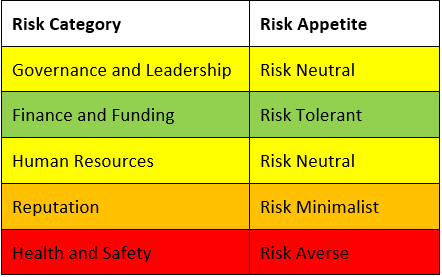
As opposed to one single overarching risk appetite, it is usually divided into categories. When it comes to risks to reputation, for example, a trust may take a strong risk averse approach because the impacts of said risk could significantly hinder the achievement of objectives (e.g. recruitment, student numbers or funding etc.).
However, risks like organisational change and development may warrant a risk tolerant approach, as a trust may be looking to grow and expand, and these elements would therefore be needed.
The following are illustrative examples of how risk appetite may be articulated within a policy, using a risk scoring model called the likelihood and impact matrix.
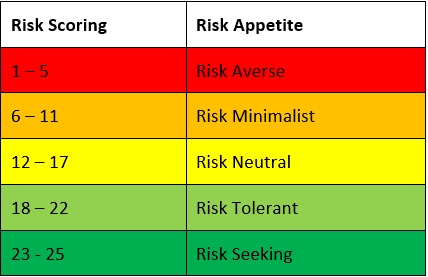
Risk appetite may then be set for each risk category in the register. Examples include:
Who is responsible for defining risk appetite in a trust?
The board of trustees is ultimately responsible for risk management in academy trusts, and it must continuously assess risk appetites and categories.
To establish and articulate risk appetite, the board must conduct an annual review of the risk register. During this exercise, each risk category may be assigned a score from 1 to 10. These scores may then be consolidated, and the average for each risk category is proposed as its risk appetite. This process is a way to define the level of risk the board is prepared to accept within each area.
Why is risk appetite important for academy trust governance?
A clearly defined risk appetite enhances transparency in business decision-making. For instance, it offers clear justification for decisions that may be considered either highly risky or cautious.
Furthermore, this process helps identify risks that may require additional resources when exposure exceeds the preferred risk appetite, or the reallocation of resources where risk levels are substantially below the established threshold.
Finally, a defined risk appetite can also help inform an academy’s internal scrutiny plan. Areas that are more risk seeking may require more assurance in terms of effective and proportionate controls.
For more in-depth guidance on how risk appetite aligns with wider governance expectations, see our guide on risk management for academy trusts.
Final thoughts
Establishing a clear and well-articulated risk appetite is essential for academy trusts that are striving to grow sustainably and demonstrate strong governance.
By defining the level of risk the board is willing to accept across each category, trusts can make more transparent, consistent and defensible decisions, ensuring resources are allocated where they are needed most.
A proactive approach to risk appetite not only strengthens strategic planning and internal scrutiny but also supports long-term organisational resilience.
If your trust is considering updating its risk appetite or wants to strengthen its risk management framework, you may find it helpful to seek additional advice or expert assistance. Feel free to reach out to our Academies team using the form below.
We always recommend that you seek advice from a suitably qualified adviser before taking any action. The information in this article only serves as a guide and no responsibility for loss occasioned by any person acting or refraining from action as a result of this material can be accepted by the authors or the firm.
Have a question about this post? Ask our team...
Sign up to receive exclusive business insights
Join our community of industry leaders and receive exclusive reports, early event access, and expert advice to stay ahead – all delivered straight to your inbox.
We can help
Contact us today to find out more about how we can help you